How to Source Bamboo Skewers with Custom OEM Packaging (2026 Buyer's Guide)
- Share
- publisher
- YADA Industrial
- Issue Time
- Oct 30,2026
Summary
A buyer's guide to OEM bamboo skewer packaging: MOQ ranges, pack counts, film specifications, container loads, landed-cost factors and the pre-order checklist importers should complete before ordering.
Sourcing bamboo skewers for retail, foodservice or distribution is more than picking a length and a diameter. If you are an importer, wholesaler or private-label brand, the packaging format, pack count, print quality and production coordination can matter as much as the skewer itself — because they decide your MOQ, your lead time and your landed cost. For your order, OEM packaging means the manufacturer produces and packs to your agreed specification — your packaging material, your printed branding, your pack quantity, your labels and your shipping cartons. Treat it as part of the product specification, not as a finishing step you sort out after production. A perfect skewer in the wrong pack still fails — on the shelf, in your warehouse, or on your customer's line. Below you will find the numbers you actually need to compare quotes: MOQ ranges, pack counts, film specifications, container loading, what each packaging format really costs you, and how to verify a supplier's packing capability before you commit. What you will get from this guide For you, OEM packaging is the bundle of decisions — packaging material, printed branding, pack count, labelling and outer carton — that you specify alongside the product itself. Fix both in writing before production starts, or you will pay to fix them later. For bamboo skewers, OEM packaging ranges from plain bulk cartons for distributors to custom-printed retail bags and boxes for private-label brands. What you choose sets your MOQ, your unit cost, and how much of the production schedule gets consumed by packing rather than by making skewers. You are really running two projects at once, and they are usually quoted and approved separately. Mixing them up is how buyers end up comparing quotes that were never comparable. Product customization defines the skewer you want: Packaging customization defines how your skewers are counted, protected, presented and delivered: Sign both off before production. If you skip this, the problems do not appear until the container lands — when fixing them costs you a second shipment. Private-label packaging is worth it when you sell under your own brand rather than distributing generic product. Your channel decides your priority, and it decides what you pay per unit. You do not always need custom printing. If your customers buy in bulk for catering or food manufacturing, a clearly labelled inner pack and a well-marked shipping carton will serve you better than a retail box — and cost you less. In our experience the decision follows one question: where does your customer open the pack? Warehouse, kitchen or shelf. Answer that, and the format usually chooses itself. Send every supplier the same written specification — dimensions, tolerances, material, application, pack count and quantity. Without that baseline you are not comparing quotes, you are comparing guesses, and the cheapest one usually has the loosest specification. If one supplier quotes you a 200 mm skewer at 5 mm and another quotes 4 mm, the price difference has nothing to do with efficiency. Moisture content is the one you are most likely to leave out — and the one most likely to cost you. Above roughly 14%, your skewers are far more prone to mould by the time the container arrives, and they feed less reliably on automated lines. A skewer you use for grilling meat has different strength and dimension requirements from a decorative pick. If your skewers run on automated food-processing equipment, you need tighter dimensional consistency — because the feeder rejects out-of-tolerance pieces and every jam stops your line. Tell your supplier how you will use the product, not just what dimensions you want. And if you already have a reference sample, a technical drawing or a spec from your current supplier, send it at the quotation stage — it saves you a full round of back-and-forth. You can review YADA Industrial's wooden and bamboo skewer range to see the available sizes, shapes and packing configurations before you finalise your own specification. Do not assume that because a product is bamboo, it automatically meets your food-contact requirement. Before you request a quotation, work out four things: your destination market, your food-contact application, the testing that applies, and the documentation your importer or retailer will demand from you. For the United States, wood and bamboo food-contact articles are not covered by a single dedicated FDA regulation the way plastics are under 21 CFR 177. Compliance is normally assessed case by case against the general food-additive framework in 21 CFR 174–190, together with your supplier's migration testing and good manufacturing practice. So when a supplier offers you “an FDA certificate” for bamboo skewers, ask what it actually is and on what basis it was issued — because a blanket FDA approval for the material does not exist. For the European Union, your framework is Regulation (EC) No 1935/2004, supported by GMP Regulation (EC) No 2023/2006. Wood and bamboo are not harmonised at EU level, so national rules apply instead — for example the German LFGB (§30 and §31) and the French arrangements for wood materials. This is why an EU declaration of compliance for bamboo skewers is usually issued against a specific national framework, not a single EU-wide standard. What that means for you, practically: This matters most when you supply regulated retail chains, foodservice distributors or food-processing businesses — because at the border, the compliance obligation is yours, not the factory's. For a deeper walkthrough, see how to verify a wooden skewer supplier's food-safety documentation. There is no universally best format, only the one that fits where your customer opens the product. Decide that first, then confirm the MOQ before you spend anything on design. Fix three numbers before you order: pieces per inner bag, cartons per pallet, gross weight per carton. Your container loading, warehouse cost and handling labour all follow from those three. Do not compare bulk quotes on unit price alone. Pieces per carton, packaging configuration and total volume all move your landed cost. Confirm the count, the counting variation you will accept (typically ±1% on machine counting), bag dimensions, closure method and carton configuration. If your product will be repacked or handled repeatedly by another distributor, specify a heavier bag gauge and check that the seal survives a drop test — a split bag in someone else's warehouse becomes your problem, not theirs. Before you approve a printed bag, check these six things — each one is a common and expensive mistake: A design that looks good on your monitor often does not survive being printed onto a 110 × 215 mm bag. Review a physical proof or a production-representative sample before you commit to a large run — it is the cheapest insurance in the whole project. Confirm box dimensions, board specification (usually 300–400 gsm folding board), print layout, barcode position and units per shipping carton. Compare the complete configuration rather than assuming that a more elaborate design gives you a better commercial result: a box can cut your cartons per container by 20–30%, purely because of the air it carries. Confirm wrapper material, individual package dimensions, opening method, sealing requirements, and whether the packing process suits your order quantity. One caution: individual wrapping does not prove sterility or any specific hygiene level. Do not let anyone — supplier or customer — describe it that way unless the process and the evidence back it up. Always confirm availability for your specific skewer dimensions, pack count and order quantity before you design anything. Six things move your number: A lower packaging cost per unit does not automatically give you a lower total purchasing cost. Model the full cube, not the piece price. Almost every packaging problem is decided before production — in artwork versions, unfixed pack counts and late label decisions. A written approval sequence removes most of them, and costs you nothing to set up. Send the latest approved artwork in the format your supplier asks for, and confirm all of this before anything is printed: If several SKUs share a similar design, label each file with the SKU it belongs to. Mixing artwork across SKUs is the most expensive error in a multi-SKU run, because the whole printed batch becomes waste — and you pay for it twice: once for the packaging, once for the delay. Your pack count sets your finished pack size, your packing method and your retail units per carton. Do not confirm it in isolation — ask your supplier whether the quantity you want actually fits the bag or box you have chosen, and whether the finished pack can be handled consistently. Ask before you design, not after. As a working reference for a 5 mm × 200 mm skewer: If you have a target carton size or pallet configuration, share it early. Packaging dimensions decide how efficiently your finished goods fit into storage and shipping — and that is your freight bill. Labelling rules for product description, barcode, language, recycling information and material claims vary by market. Give your supplier the requirements from your importer, retailer or compliance team, and agree in writing who approves the final packaging information — you do not want to discover a missing requirement after 50,000 bags are printed. Claims such as “compostable”, “biodegradable” or “food-safe” should only appear where you can support them with evidence for the product, the packaging and the market. Describing the material as bamboo does not establish the compliance status of the finished product — and an unsupported claim is your liability as the importer, not the factory's. Check in this order: For repeat orders, keep the approved specification, the artwork version and the physical sample. That gives you a fixed reference, and makes any drift visible the moment it happens. Yes — when the equipment suits your skewer dimensions, your film and your pack count. Automation standardises pack counts and seal quality, but it does not remove the need for inspection, and it will not rescue a bad specification. So the question worth asking is not whether your supplier owns an automatic packaging machine. It is whether that machine can run your order to your requirements. Automation does not eliminate quality control for you. Pack counts, seal integrity, print registration and finished-pack dimensions still have to be checked against criteria you have agreed — and you should know who checks them and what record you get. Ask your supplier directly: These questions will tell you more than any general claim that automated packaging is faster or cheaper. A supplier-operated packing arrangement can also save you from buying and maintaining your own equipment — whether that works commercially for you depends on the supplier's service model, your order volume and your terms. You can have a perfectly good product and still lose the shelf to a competitor with better packaging. That was exactly this customer's situation. A bamboo skewer brand supplying retailers and distributors across Southeast Asia had been selling in hand-packed bags. The product performed. The packaging did not. Competing products on the same shelf used consistent, custom-printed packs, and hand-packed bags no longer matched the brand's positioning. Buying packaging machinery was not part of their plan. Equipment would have brought maintenance, depreciation and the risk of idle capacity — a poor fit for an order pattern with several SKUs and variable volumes. What they needed was a supplier who could coordinate the skewers and the customised packaging inside the manufacturing arrangement, so they did not have to build a packing operation of their own. YADA Industrial developed and operated an automated bamboo skewer packaging line specifically to support flexible custom orders. For this project it included: That 35 micron figure was chosen for this project. It is not a universal recommendation for your packaging — the right gauge depends on your pack weight, your print coverage and the protection your market requires. The customer has taken five container shipments with YADA Industrial since October 2025. The documented repeat order was a full container of 1,800 cartons of branded bamboo skewers. In the customer's own assessment, the packaging upgrade gave them a more professional shelf presentation without any investment in their own packaging equipment. Compare suppliers on five things — specification discipline, packaging capability, documentation, quality-control evidence and repeat-order reliability. Price only means something once the other four are equal. Send every supplier the same dimensions, material, packaging format, pack count, artwork requirement and quantity. Then ask for costs itemised where possible: Not every quote will separate these, but the more clearly a supplier defines them, the easier your comparison — and the less room there is for a surprise invoice later. Ask which processes happen in-house and which are outsourced — including bamboo processing, polishing, sorting, printing and packing. If custom packaging matters to your project, ask for equipment information, examples of comparable work, how SKUs are managed, which formats are available, and what their packing inspection procedure is. A supplier who runs manufacturing and packaging under one coordinated process will make your life easier. But verify the capability and the responsibility for your order, not the capability list on their website. Review product and material identification, applicable test reports, testing scope and conditions, document dates and issuing organisations — then check whether the tested sample actually represents the product you are ordering. Separately, confirm which regulatory and labelling requirements apply where you are selling. Ask for samples that cover both the skewer and the finished pack, and agree measurable acceptance criteria: Then ask how inspection results are recorded, and what happens to product that fails your criteria. A supplier who cannot describe that process will not be able to honour it. Ask whether the MOQ applies per product specification, per SKU, per artwork design, per packaging material or per packaging format. These are different numbers, and across a multi-SKU range they multiply. Do not assume the manufacturing lead time your supplier quotes includes artwork approval, packaging material preparation and international delivery. It usually does not. Work through this before you issue an RFQ, and again before you approve a quotation. Complete this before you issue a purchase order. It removes the ambiguity that turns into delays, and it gives you and your supplier one shared reference for the whole production run. Yes. You can arrange custom-printed packaging whenever the manufacturer supports the printing and packing format you need. Expect a typical minimum of 5,000–10,000 pieces per artwork design for printed film or bags. Confirm the material, print area, pack count and quantity before you ask for a final quotation. You can choose bulk cartons, counted inner bags, printed retail bags, retail boxes or individual wrappers. Bulk cartons cost you the least per unit; printed retail boxes the most. Your best option depends on your sales channel, your handling requirements, your branding needs and your total packaging cost. Your skewer MOQ typically starts at 10,000 pieces per SKU. Your custom-printed packaging usually starts at 5,000–10,000 pieces per design. The number moves with packaging type (film vs. rigid box), number of print colours, and how many SKUs share one run. Below roughly 5,000 pieces per design, stock bags plus a printed label will usually cost you less than a custom run. Yes, subject to the manufacturer's counting capability and the format you choose. Common pack counts are 100, 250, 500 and 1,000 pieces, with counting variation typically held to ±1%. Specify pieces per pack, the variation you will accept and packs per carton before production. Send print-ready artwork, logo files, colour references and final product information. Confirm printed dimensions, bleed, barcode quiet zone (≥3 mm) and who signs off. Review a representative proof or physical sample before mass production, and keep the approved version under revision control — that file is your protection on repeat orders. Often yes for adjacent sizes, but not across large jumps. Skewers within roughly ±20 mm of the design length can usually share a bag; beyond that, bag dimensions, pack weight and SKU identification will force a separate specification. Confirm product fit, finished-pack dimensions and labelling with your manufacturer before you commit to one design. Product MOQ is the minimum for manufacturing your skewers — typically 10,000 pieces per SKU. Packaging MOQ is the minimum for producing or buying your packaging materials — typically 5,000–10,000 pieces per artwork design for printed formats. The two can differ significantly, especially when printed bags or boxes need their own production run. For multi-SKU projects, ask whether the packaging MOQ applies per design, per material or per SKU, because that is where your budget can quietly double. A 40'HQ carries roughly 6–12 million 5 mm × 200 mm skewers, or 800–1,800 cartons, depending on pack count, carton size and whether the product is individually wrapped. Carton dimensions usually limit your load before weight does, because bamboo skewers are light for their volume. Bamboo skewers are normally classified under HS 4421.91, other articles of wood — of bamboo. Rates and documentary requirements vary by destination, so confirm the classification with your customs broker: finished tableware and coated articles can fall under different subheadings. Printed film or bags typically add 3–8% to your unit cost, depending on print coverage, number of colours and volume. Rigid retail boxes add more — commonly 10–20% — because of material and packing labour. Your cost per unit falls as volume rises, which is exactly why the MOQ threshold matters commercially. Yes. Equipment availability, packaging-material preparation, artwork approval, changeovers and sample confirmation all affect your schedule. Automated lines pack faster but need 30–120 minutes of changeover between SKUs. Confirm the full timeline, not just the skewer manufacturing time. Yes, in some cases. A supplier with suitable equipment can manufacture and pack branded product as part of your supply arrangement — useful if you want customised retail packaging without investing in your own line. Confirm the service scope, minimum quantities, costs and production requirements with them before committing. Plan 45–60 days from artwork approval to arrival: artwork approval (3–5 days), packaging material production (7–15 days), skewer production (15–25 days), packing (3–7 days), inspection (2–3 days) and sea freight (20–35 days). Add buffer for peak season, and more for your first order with a new supplier. 8–12% is the usual working range for foodservice and machine-fed skewers. Above roughly 14%, your mould risk in transit rises sharply and automated feeders become unreliable; below about 6%, skewers turn brittle and snap more easily — which your customers will notice before you do. Yes, and it usually lowers your freight per unit — but it complicates packing. Confirm the minimum quantity per SKU your supplier will accept for a mixed container, how cartons will be marked and segregated, and whether the shipping marks let your consignee split the delivery without opening every carton. Sourcing bamboo skewers with custom OEM packaging is not a product decision with a packaging add-on. Your skewer specification, packaging format, pack count, artwork, quality criteria and delivery schedule all constrain each other, and they have to be aligned before mass production — not after. A process that works: Get those five right and the packaging stops being a risk. You end up with a product that arrives in the format you specified, at a cost you modelled in advance, from a supplier who can repeat it on your next order. YADA Industrial supplies wooden and bamboo skewers with customization across product specifications, packaging and branding. If you are planning a new private-label project or upgrading an existing skewer line, send us your target dimensions, packaging format, pack count, estimated quantity and required delivery date — and we will come back to you with a specification and a costed packaging option. Explore YADA Industrial's wooden and bamboo skewer range or tell us about your custom OEM requirements to start planning your next packaging project. Planning a private-label skewer project? Send your target dimensions, packaging format, pack count and delivery date, and the YADA Industrial team will come back with a specification and a costed packaging option. YADA Industrial Co., Ltd. is a Chinese manufacturer of wooden and bamboo skewers and disposable eco-friendly tableware, headquartered in Dalian with production bases in Dalian, Fujian and overseas. The company has supplied foodservice, retail and food-processing buyers in 60+ countries for over 30 years, shipping 1,200+ containers a year from 100,000+ m² of production space, including a 3,000 m² Class 100,000 clean workshop. Certifications include ISO 9001, GMP, BRC, Sedex, FSC® and SGS-audited food-contact testing; raw material is secured from 666+ hectares of owned bamboo forest. Last updated: October 2026 · Reviewed by the YADA Industrial packaging and quality-control team.
What Does OEM Packaging Mean for Your Bamboo Skewer Order?
Product customization vs. packaging customization
Parameter Typical range What you should confirm Length 90–300 mm (200 mm is the most common foodservice size) Finished length, ±1 mm tolerance Diameter 2.5–6.0 mm round; 3 × 10 mm flat Measured at mid-point, ±0.3 mm tolerance Shape and tip Round, flat, twisted-end, knotted, semi-pointed, sharp Tip geometry for the food you will thread Material Moso bamboo (Phyllostachys edulis) is the standard Species or agreed grade, if you specify one Surface Polished, splinter-free, no visible mould or cracks Acceptable visual variation, sampling plan Application BBQ, catering, retail, food processing Machine-fed vs. hand-fed use When does private-label packaging make sense for you?
Your sales channel Your priority Typical format Relative packaging cost Supermarket and retail brand Shelf presentation, barcode, brand consistency Printed retail bag or box High Importer or distributor Handling efficiency, carton identification Bulk carton, poly-lined inner bag Low Foodservice distributor Fixed pack counts, fast picking Counted inner bag Low to medium Food-processing business Equipment compatibility, hygiene control Bulk or individually wrapped Medium QSR and takeaway chain Cost per unit, dispensability Bulk carton Lowest Define Your Bamboo Skewer Specifications Before You Request a Quote
The specification sheet to send
Specification What you should confirm Typical value to state Length Finished length in millimetres 200 mm ±1 mm Diameter Diameter, or width × thickness 5.0 mm ±0.3 mm Shape and tip Round, flat, pointed, semi-pointed, knotted Round, semi-pointed Material Bamboo species or agreed grade Moso bamboo, food-contact grade Surface quality Smoothness, splinters, cracks, discolouration No splinters; cracks ≤2% per 1,000 pcs Moisture content Drives machine feeding and storage life 8–12% Application BBQ, catering, retail, food processing Machine-fed, 200 pcs/min line Order quantity Total and per-SKU volume 500,000 pcs across 2 SKUs Quality criteria Tolerances and inspection standard AQL 2.5, major defects Match the skewer to how you will use it
Your application Your priority What that means for your spec BBQ and kebab Strength, length, heat resistance 4.0–6.0 mm diameter, sharp or semi-pointed tip Fruit and appetiser picks Appearance, presentation Decorative top, 2.5–3.5 mm diameter Food processing Dimensional consistency Tight tolerances, controlled moisture, machine-grade sorting Retail multi-packs Standardisation across SKUs One or two fixed lengths across your whole range Confirm what your market actually requires for food contact
Choose the OEM Packaging Format That Fits How You Sell
Bulk cartons for importers and distributors
Parameter Typical value Why it matters to you Pieces per inner bag 1,000–5,000 Sets how finely your customers can pick Gross weight per carton 12–20 kg Above 20 kg you need handling equipment Cartons per 40'HQ 800–1,800 Driven by carton size, not weight Carton strength 5-layer corrugated for export Protects you against stacking and humidity Shipping marks SKU, quantity, lot, dimensions, weight Saves you arguments at customs and in the warehouse Counted inner packs for foodservice
Printed retail bags for private-label brands
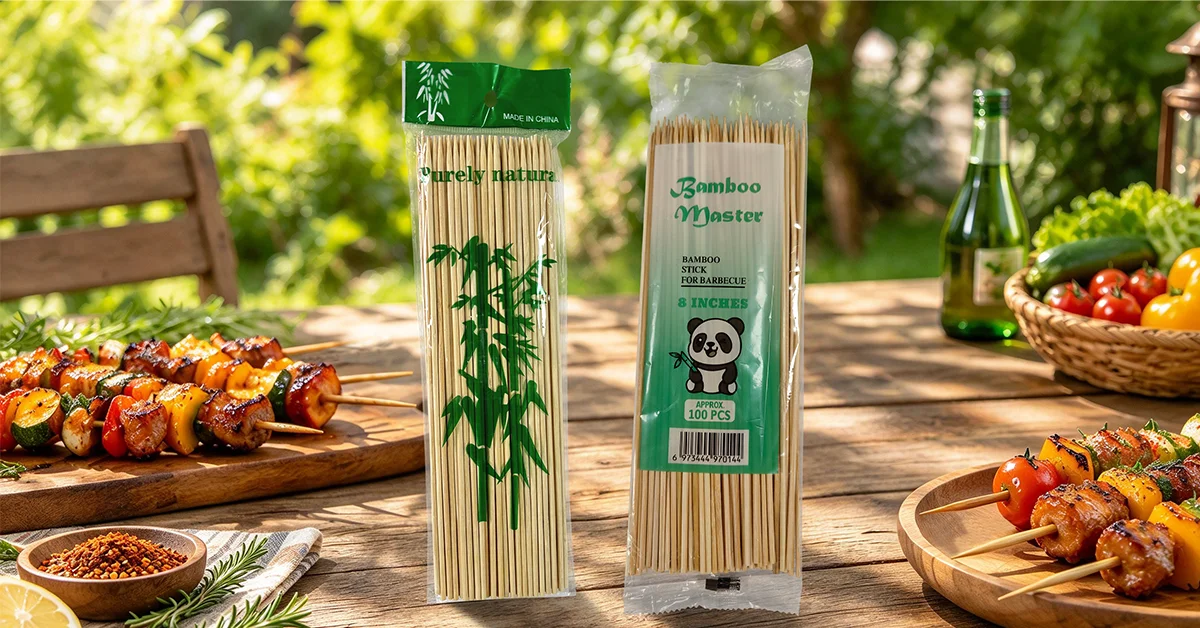
Item Typical specification What goes wrong if you skip it Film material CPP, PE or BOPP, 30–60 μm Film too thin for your pack weight Bag dimensions Fits your pack without excess slack Bag sized before pack count was fixed Print area Leave 8–10 mm seal margin Your artwork bleeds into the seal Colour reference Pantone or CMYK proof Screen colours never matched to print Barcode EAN-13, quiet zone ≥ 3 mm Your barcode will not scan at retail Closure Heat seal or resealable strip Seal fails somewhere in transit Printed retail boxes
Individually wrapped bamboo skewers
Packaging options at a glance
Packaging format Typical buyer Typical MOQ per design Relative unit cost Protection Shelf appeal Bulk carton Importer, wholesaler 10,000 pcs (SKU MOQ) Lowest Good in transit None Counted inner bag Foodservice distributor 10,000 pcs Low Good None Printed retail bag Private-label brand 5,000–10,000 pcs Medium Good High Printed retail box Retail brand 3,000–5,000 pcs Highest Best Highest Individual wrapper Specified foodservice or retail 50,000 pcs+ High (+15–30%) Best Medium What OEM packaging does to your landed cost
Customize Your Packaging Without Creating Production Problems
Give your supplier print-ready artwork
Confirm pack count and finished dimensions
Pack count Approximate finished pack Typical use 100 pcs 110 × 215 mm bag Retail single pack 500 pcs 130 × 230 mm bag Retail or small foodservice 1,000 pcs 150 × 250 mm bag Foodservice 5,000 pcs Bulk inner bag in carton Distribution Check labels against your market before you print
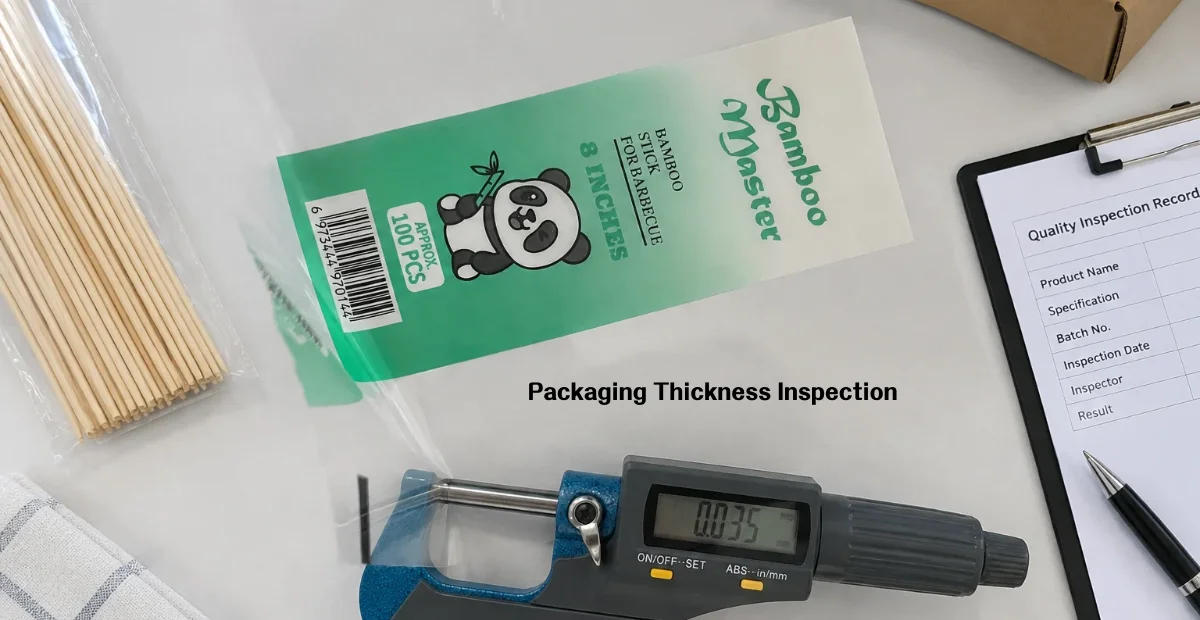
Approve a sample that represents the real thing
Can Automated Packaging Make Your Orders More Consistent?
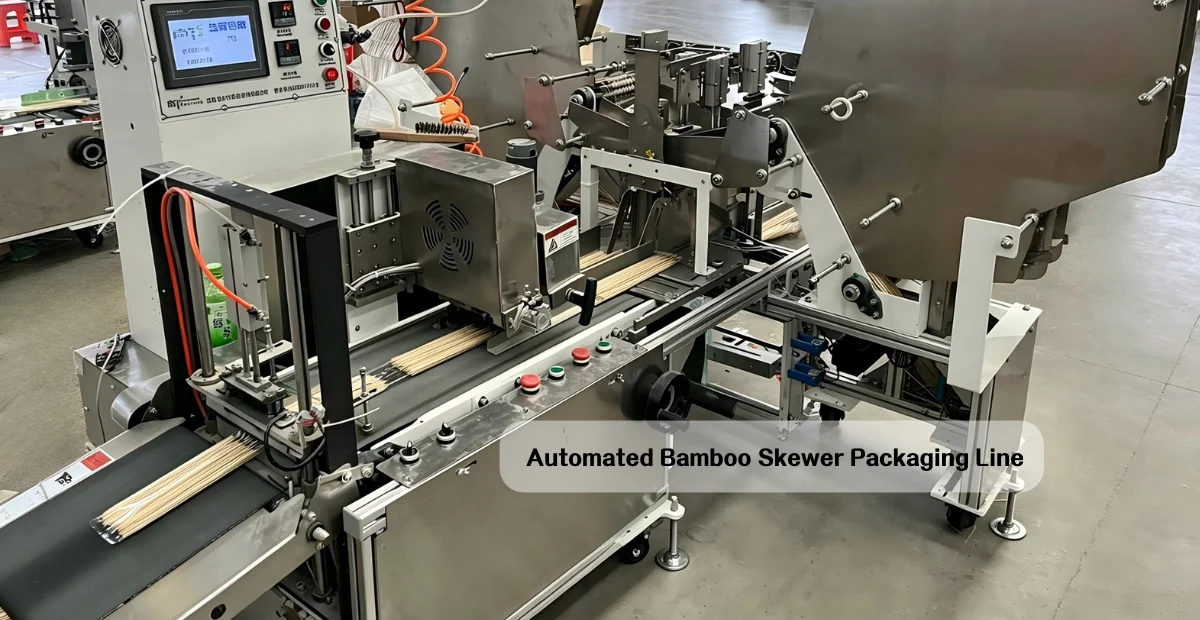
Manual packing vs. automated packing
Factor Manual packing Automated packaging Pack count consistency Depends on operator counting discipline ±1% or better, set by counter Output 8–15 packs/min per operator 40–80 packs/min per line Printed film Possible, usually pre-printed bags Integrated printed-film packing Changeover Immediate, no setup 30–120 min, requires settings and validation Economical volume Low to medium Medium to high Quality checks Defined manual checks Still needs inspection and process monitoring What to confirm before you accept an automated packing format
A Real Example: Upgrading Packaging Without Buying Equipment
The challenge you may recognise
What YADA Industrial did
The result
What you can take from it
How to Evaluate Manufacturers Beyond the Unit Price You Are Quoted
Compare quotes built on the same specification
Cost element What to ask Typical treatment Skewer manufacturing Based on which exact specification? Per 1,000 pcs Inner packaging Bag type and pieces per bag included? Per pack or included Outer cartons Carton spec and quantity included? Per carton Printed film, bag or box Included, or charged separately? Usually separate Printing setup Plate or cylinder cost per design One-off per design Samples Free or charged, and who pays courier Often free, you pay freight Inspection Pre-shipment inspection included? Negotiable Shipping terms Which Incoterm? FOB / CIF / DDP Verify the capability you are actually buying
Check their documents against your market
Review samples and quality control together
Confirm MOQ, lead time and repeat-order consistency
Stage Typical duration Who controls it Artwork preparation and approval 3–5 days You — and this is the most common delay Packaging material production 7–15 days Supplier Skewer production 15–25 days Supplier Packing 3–7 days Supplier Inspection and documentation 2–3 days Supplier Sea freight 20–35 days Carrier Your Pre-Order Checklist for OEM Bamboo Skewer Packaging
Item What you need confirmed Typical value / range Product specification Length, diameter, shape, tip, material 200 × 5.0 mm, round, semi-pointed, Moso bamboo Tolerances Dimensional and moisture limits ±1 mm length, ±0.3 mm diameter, 8–12% moisture Intended application BBQ, foodservice, retail, processing Machine-fed foodservice Packaging format Bulk carton, counted bag, printed bag, box, wrapper Printed retail bag Pack count Pieces per pack and packs per carton 100 pcs/bag, 50 bags/carton Packaging material Material, thickness, relevant requirements CPP film, 40 μm, food-contact grade Finished pack dimensions Bag or box size and seal margin 110 × 215 mm, 8 mm seal Branding Approved logo, colours, layout, revision date Artwork v3, Pantone 3435C Labelling Product info, barcode, market requirements EAN-13, EN labelling Sample approval Product sample and packaging proof Signed sample retained Quality standards Tolerances, pack-count criteria, AQL AQL 2.5 major defects Order quantity Total and per SKU 500,000 pcs across 2 SKUs MOQ and costs Product MOQ, packaging MOQ, setup charges 10,000 pcs/SKU; 5,000 pcs/design Production schedule Artwork, materials, production, inspection 45–60 days to arrival Shipping configuration Carton dimensions, gross weight, marks 20 kg max, 5-layer corrugated Repeat orders Retained specification, artwork, change control Version-controlled file set Frequently Asked Questions
Can I order bamboo skewers with custom-printed packaging?
What packaging options are available for bulk bamboo skewers?
What MOQ should I expect for custom OEM bamboo skewer packaging?
Can I customize the number of skewers in each pack?
How do I prepare artwork for private-label bamboo skewers?
Can different bamboo skewer sizes share the same printed packaging?
What is the difference between product MOQ and packaging MOQ?
How many bamboo skewers fit in a 40-foot container?
What is the HS code for bamboo skewers?
How much does custom printed packaging add to my unit cost?
Will automated packaging affect my lead time?
Can I get custom packaging without buying packaging machinery?
How long does a custom OEM bamboo skewer order take?
What moisture content should my bamboo skewers have?
Can my supplier pack different SKUs into one container?
Source Your Skewers and Packaging as One Project
Keep reading
About YADA Industrial