How to Find a Reliable Ice Cream Stick Supplier in China: 2026 B2B Sourcing Guide
How to Find a Reliable Ice Cream Stick Supplier in China: 2026 B2B Sourcing Guide
Share
publisher
YADA Industrial
Issue Time
Nov 6,2026
Summary
A practical sourcing guide for importers: how to verify a Chinese ice cream stick manufacturer, which specifications and quality limits to confirm, which food-contact documents to request, and how to compare MOQ, packaging and samples before a bulk order.
Sourcing ice cream sticks from China is less a price exercise than a manufacturing control exercise. A stick that looks right on a sample table can still jam a filling line, splinter in a consumer's hand, or fail a food-contact check at the port of entry. This guide sets out what to verify, in what order, and which documents to hold before you commit to a bulk order.
Short answer
A reliable ice cream stick supplier in China is a direct manufacturer that can document three things on paper: material identity and traceability, measurable stick quality (dimensions, straightness, moisture, surface finish) and food-contact documentation that matches your destination market. Ask for the factory, the per-lot certificate of analysis, product-specific test reports and a sample from current production. Then run that sample on your own machine before the first bulk order.
Six checks that separate a real manufacturer from a reseller
OwnershipWho owns the workshop, the lines and the drying kilns.
SpecificationLength, width, thickness, end shape, tolerance, straightness.
Measurable QCWhat is inspected, how often, recorded per lot or not.
DocumentsProduct-specific reports, not one general certificate.
Commercial termsMOQ, packing, carton count, Incoterms, lead time.
Machine trialFeeding, insertion depth and jamming on your own line.
Define Your Ice Cream Stick Requirements Before Sourcing
Short answer: write a one-page specification before you email any supplier — material, length, width, thickness, end shape, surface finish, straightness and moisture limits, packing configuration and the machine the stick will run on. Identical specifications are the only way to compare quotations.
Most sourcing problems start before the first email. A buyer sends "93 mm ice cream sticks, please quote" to five suppliers, receives five prices that differ by 30 percent, and cannot tell whether the difference is margin, material, thickness, packing or inspection. A written specification removes that ambiguity and lets each manufacturer tell you honestly whether its lines can produce what you need.
Before contacting an ice cream stick supplier, prepare a clear product specification. It should cover the material, the stick geometry, the quality limits you will measure at goods-in, the packing configuration and the destination market, because each of these changes the price and the production route.
Which Material Should You Choose: Birch Wood or Bamboo?
Birch wood and bamboo are the two material options for disposable ice cream sticks. Both are food-contact safe when processed correctly, and both can be produced to machine-grade tolerances. The right choice depends on your product design, the surface and grain you want under the ice cream, the processing route your supplier controls, and what your destination market expects.
Birch wood ice cream sticks. Birch is the default material for flat wooden sticks because its relatively uniform grain structure makes it suitable for producing thin, flat sticks with smooth surfaces after polishing. It machines cleanly, holds a consistent cross-section, and accepts hot-stamp and laser branding. Typical applications include traditional popsicles and ice cream bars, branded frozen dessert products, mini and full-size sticks, and any application that depends on consistent dimensions and appearance.
Bamboo ice cream sticks. Bamboo is the second natural option. Its material characteristics, raw-material preparation and processing requirements differ from birch: bamboo culms are split and shaped rather than sawn and turned, the fibre direction is different, and surface finishing needs a different pass sequence. Buyers choose bamboo when they have a material preference, a sustainability story that needs a fast-growing grass rather than a hardwood, or a sourcing requirement tied to a specific origin.
Neither material should be selected on appearance alone. Ask the supplier to identify the species, explain the processing route, and provide documentation for the exact material you are buying.
Evaluation factor
Birch wood
Bamboo
Material type
Natural hardwood, uniform grain
Natural bamboo, split and shaped
Typical application
Popsicles and ice cream bars on automatic lines
Frozen dessert applications where bamboo is specified
Processing route
Sawn, kiln dried, rounded, wax polished
Split, shaped, dried, polished
Key considerations
Grain, thickness consistency, straightness
Surface finish, material consistency, node handling
Branding options
Hot stamping, laser engraving
Hot stamping, laser engraving
Documentation
Food-contact reports, FSC chain of custody
Food-contact reports, FSC chain of custody
Birch and bamboo sticks are graded after polishing, not before. Ask to see the inspection stage, not only the finished bundle.
What Ice Cream Stick Sizes and Specifications Should You Confirm?
Short answer: confirm six specifications — length, width, thickness, end shape, surface finish and straightness — plus a moisture range. Lengths of 93 mm and 114 mm cover most automatic lines; 60–70 mm serves mini formats and 140 mm serves large or filled lollies.
The main specifications to confirm are length, width, thickness, end shape and surface finish. Length determines how much of the stick extends beyond the ice cream and how it sits in the mould; width influences the contact area and the finished look; thickness controls rigidity, which is what a machine actually feels when it inserts the stick.
Common lengths are 70 mm, 93 mm and 114 mm, with 60 mm and 140 mm formats also produced for mini and large applications. Standard specifications are a practical starting point, but custom dimensions are often necessary when your product uses a particular mould, a packaging design or an automatic insertion system.
Specification
Typical range
Why it matters
Length
60, 70, 90, 93, 114, 140 mm
How far the stick protrudes; fit with the mould depth
Width
8, 10, 15, 20 mm
Contact area, rigidity across the flat face
Thickness
1.3, 2, 2.5 mm
Rigidity, insertion resistance, magazine stacking
End shape
Round, straight, bevelled
Consumer comfort, feed orientation in the hopper
Surface finish
Unpainted, wax polished, splinter-free
Mouth feel, release from the mould, branding quality
YADA Industrial publishes two standard birch specifications that cover most automatic lines: a mini stick at 93 × 10 × 2 mm and a full-size stick at 114 × 10 × 2 mm, packed 50 pieces per bundle and 200 bundles per carton. Bamboo versions of the same lengths are also produced. Customised dimensions can be discussed against the intended application and the technical limits of the line.
If you use automatic stick insertion equipment, send the manufacturer the equipment model, the mould drawing and the required dimensions rather than a length alone. A suitable supplier will evaluate whether the proposed specification matches your production reality instead of quoting a catalogue item.
Match the Stick Specification to Your Application
Different frozen dessert applications put different demands on the stick. A stick that performs well in a hand-filled mould may be too flexible for a high-speed inserter, and a stick that survives an inserter may look too plain for a premium retail pack.
Application
Specifications that decide performance
Traditional popsicles
Length, thickness and surface smoothness
Ice cream bars
Dimensions, rigidity and handling on the line
Premium frozen desserts
Appearance, edge finishing and branding
Industrial production
Dimensional consistency, straightness and machine compatibility
Private-label products
Custom dimensions, logo and retail packaging
Every stick ends up in front of a consumer. Retail presentation, mould release and cold-storage stability are part of the specification, not an afterthought.
How to Verify an Ice Cream Stick Manufacturer in China
Short answer: separate the manufacturer from the trader before you discuss price. Ask who owns the workshop, which processes run in-house, how many lines serve ice cream sticks and what the daily output is. Then ask for evidence you can check: factory video, line photographs, an audit report or a live video call during production.
One of the most important steps in sourcing ice cream sticks from China is distinguishing a direct manufacturer from a trading company. A manufacturer operates production facilities and manages at least part of the manufacturing process. A trading company coordinates sourcing and sales. Both can supply good products, but production control, customisation capability, problem resolution and communication arrangements differ — and the difference shows up exactly when something goes wrong.
Check Factory Ownership and Manufacturing Experience
A reliable manufacturer should be able to describe its production operations without hesitation: where the raw material enters, how it is dried, which machines shape and polish the stick, how defects are sorted, and how finished cartons are stored before shipment. Years in business help, but they are not proof on their own.
How many years has the company manufactured wooden or bamboo products?
Does it operate its own production facilities, or does it outsource part of the process?
Does it have dedicated ice cream stick lines, or does the stick share capacity with cutlery and skewers?
Which processes are handled in-house: drying, rounding, polishing, printing, packing?
Can it provide factory photographs, a production video or a live online factory tour?
Experience matters because it shows familiarity with raw-material selection, drying behaviour and repeat-order management. It does not replace verification. Buyers should still confirm equipment, process flow and quality management directly.
Evaluate Production Capacity and Automation
Capacity becomes the deciding factor for buyers placing large or seasonal orders. Frozen dessert demand is concentrated: a program that needs 20 million sticks between March and August cannot be served by a factory that plans capacity month to month.
Number and type of ice cream stick production lines.
Raw material processing and drying capability, including kiln capacity.
Polishing and edge-finishing equipment.
Sorting and inspection systems, and what they actually detect.
Production planning, warehouse management and repeat-order coordination.
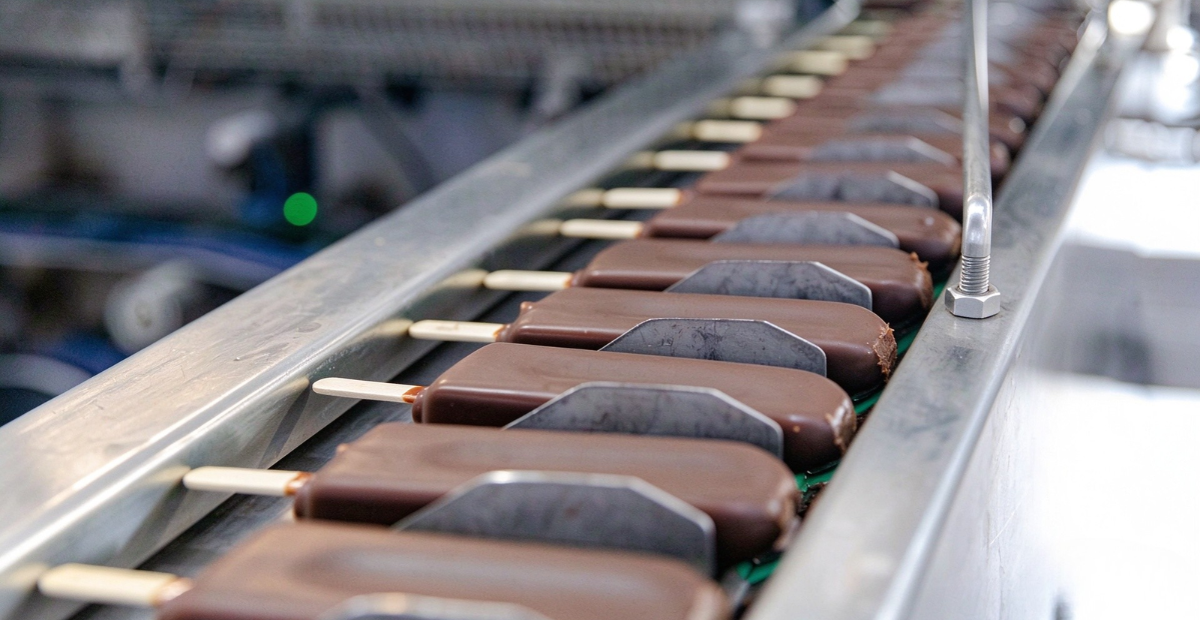
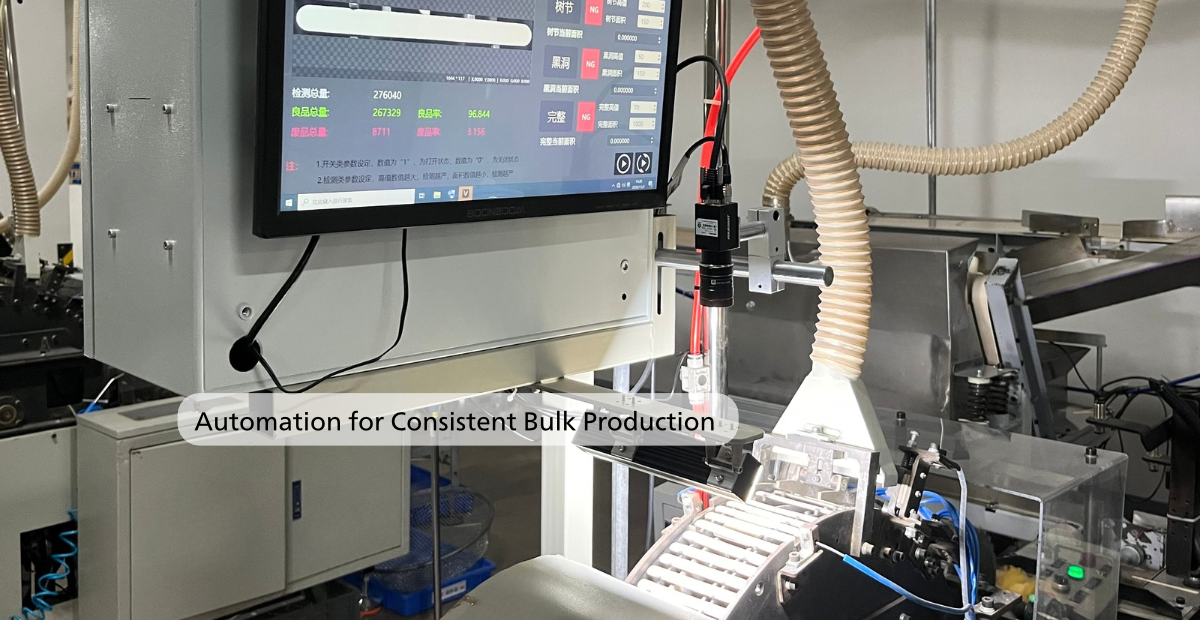
Automation improves consistency and reduces reliance on manual inspection, but automated equipment does not automatically guarantee quality. A camera sorter is only as good as the defect library it was trained on and the maintenance it receives. Ask what the equipment checks, which defects it can identify, what it rejects, and how results are recorded per batch.
Automation reduces handling, but the useful question is what the line measures. Ask for the defect list, not the equipment brand.
Request Verifiable Manufacturing Evidence
Do not rely entirely on website descriptions or promotional claims. Where possible, request evidence that ties a document to a factory and a date:
Factory and workshop photographs, ideally with a date or a live call.
Video of the specific processes your product needs.
Samples taken from current production, not from a showroom drawer.
Quality inspection records with lot numbers.
Factory audit reports and management-system certificates with a valid scope.
For larger projects, a third-party factory audit or a pre-shipment inspection is money well spent. The objective is not to catch a supplier out; it is to confirm that the facilities, processes and management systems exist to reproduce your specification order after order.
How to Evaluate Ice Cream Stick Quality
Short answer: judge a stick on four measurable characteristics — surface and splinter control, dimensional accuracy and straightness, moisture content, and the effectiveness of sorting. Ask for the acceptance limits in writing, then check the numbers on the certificate of analysis that ships with each lot.
Quality is the factor that most directly affects your line and your brand. A suitable manufacturer should be able to explain which characteristics it controls, how defects are identified, and how an approved specification is held across batches — not only on the day of the sample.
Surface Smoothness and Splinter Control
Smooth surfaces and properly finished edges matter for consumer comfort, for mould release and for packing. Common defects include wood splinters and loose fibres, rough patches and burrs, uneven edges, surface cracks and irregular polishing marks. These defects are felt by the consumer and can also cause handling problems in packing and feeding.
Ask about the finishing process: mechanical rounding, two-stage polishing, edge finishing, and the inspection step that follows. When the sample arrives, examine both faces, all four edges and both ends under good light. Photographs cannot substitute for this — a rough edge photographed at 1200 pixels looks smooth.
Dimensional Accuracy and Straightness
Dimensional consistency matters most when sticks run through automatic equipment. Variations in length, width or thickness affect feeding, insertion depth and positioning, and small drifts accumulate into line stops.
Straightness deserves equal attention. A stick that bows or twists can still be inserted, but it may sit at the wrong angle, crack the ice cream shell, or fail a downstream quality camera. Instead of accepting descriptive words such as "straight" or "uniform", agree on measurable limits before bulk production.
Measurement
What it describes
How to verify
Nominal dimensions
Length, width and thickness as ordered
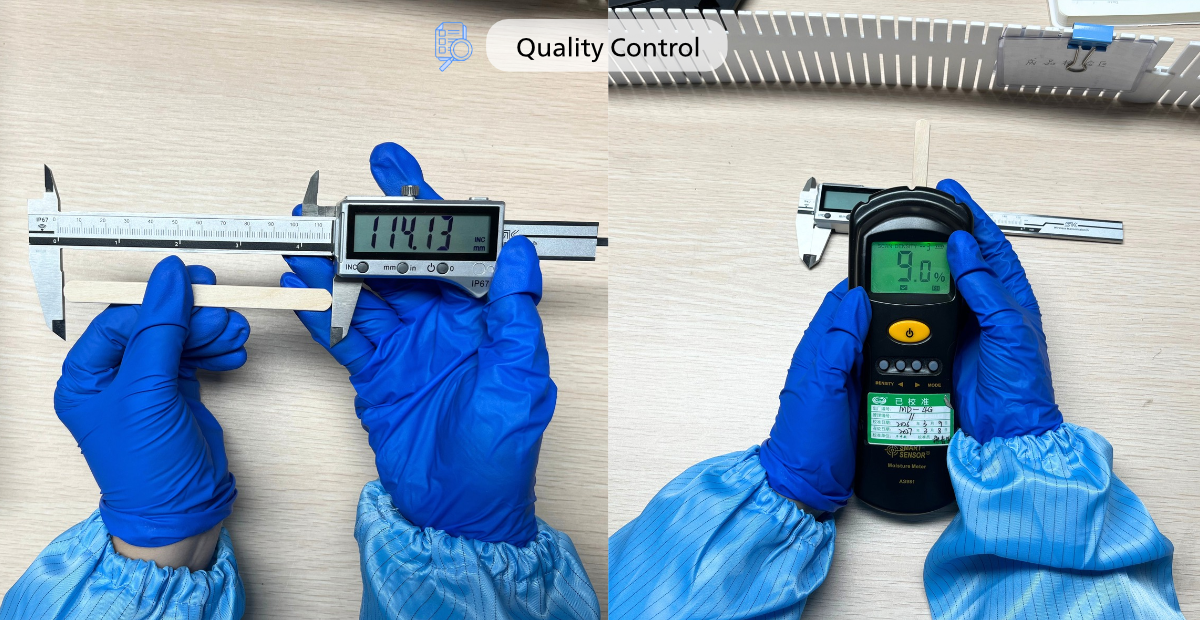
Caliper measurement on a defined sample size
Dimensional tolerance
Acceptable deviation from nominal
Written limit plus goods-in sampling plan
Straightness
Bowing along the length and twisting across it
Flat-plate or gauge check, recorded per lot
Surface defects
Splinters, burrs, cracks, polishing marks
Visual inspection against a photo defect standard
Moisture
Water content of the finished stick
Meter reading recorded on the lot certificate
Published limits help you write your own. For its ice cream stick production, YADA Industrial states a moisture target of 12 percent or below, a curve limit of 2.8 mm and a zig-zag limit of 2.8 mm, with a separate allowance of 10.4 mm for the "banana" curvature pattern, all recorded per lot on the certificate of analysis. Whatever limits you agree, they belong in the purchase order.
Moisture Content and Wood Stability
Moisture is the quiet variable in wooden sticks. Excessive or uneven moisture changes dimensional stability, encourages mould in transit, and makes sticks feel soft on the line. Drying method and packing conditions decide how the product behaves between the factory and your freezer.
Does the supplier use controlled kiln drying, and at what schedule?
What moisture range is specified for the finished stick?
How is moisture measured — meter, oven method, or both?
Are finished goods stored in a dry, ventilated area before loading?
Is moisture checked during production, before shipment, or both?
The applicable moisture requirement depends on the material, the stick thickness and the destination climate, so confirm it for your order rather than copying a number from another project.
Sorting and Quality Inspection
Inspection methods vary widely: manual visual inspection, mechanical screening, and automated optical sorting are all used, often in combination. For larger orders, understand exactly what is checked and what happens to the rejects.
Which characteristics are inspected, and against which limits?
Is inspection performed inline, after polishing, or before packing?
How are defective sticks identified, counted and separated?
Are results recorded by batch, and can you see the record?
How are non-conforming lots handled — rework, downgrade or scrap?
Inspection data is only useful if it is readable per lot and tied to a specification. Ask for a sample record before you ask for a price.
The question is not whether a manufacturer owns an inspection machine. It is whether the inspection process addresses the defects that matter for your product, and whether the record proves it happened on your order.
What Food Safety Documents Should Ice Cream Stick Importers Request?
Short answer: request three separate things — product-specific food-contact test reports, a declaration of compliance or certificate of analysis for the batch, and factory management certificates (ISO 9001, BRC, GMP, Sedex). They are not interchangeable, and a management certificate is not evidence that the product passes a migration test.
Wooden and bamboo ice cream sticks come into direct contact with food, so buyers must confirm that the product meets the applicable food-contact requirements in the destination market. Which documents are required depends on the material, the product, the intended use and the destination country.
Check Raw Material Identification and Traceability
Start with the material, because every later document refers back to it. Ask which wood or bamboo species is used, whether the source can be identified, how incoming material is inspected, and whether lots can be traced forward to your shipment.
Species and origin of the wood or bamboo used.
Whether the material comes from owned forest, a long-term supplier, or the open market.
Incoming inspection criteria for raw material.
Batch coding that links raw material to finished cartons.
FSC chain-of-custody documentation where certified sourcing is required.
Traceability is what allows a buyer to answer a question six months later: which material, which line and which inspection record produced the cartons in this container. Suppliers that cannot answer it at the quotation stage rarely can after the fact.
Request Product-Specific Food-Contact Test Reports
Food-contact requirements differ between markets. Buyers importing into the European Union or the United States should identify the requirement that applies to their product instead of assuming one general certificate covers every market. For orientation: in the EU, Regulation (EC) No 1935/2004 sets the general framework for food-contact materials and Regulation (EC) No 2023/2006 sets good manufacturing practice; in the US, indirect food additives are regulated under 21 CFR Parts 174-178, beginning with 21 CFR Part 174.
Product-specific food-contact test reports, not a company-level certificate.
Declarations of compliance where the destination market requires one.
Material and product specifications referenced in the report.
Laboratory testing records and the lab's accreditation.
When you review a report, check the exact product and material tested, the test methods used, the issuing laboratory, the report date and the scope against your destination market. A report for one stick specification should not be assumed to cover every material, size or customised version from the same manufacturer.
Review Factory Management Certifications
Management certifications add information about how a factory is run. Depending on actual status and scope, relevant examples include the following systems.
Certification or system
What it covers
What it does not prove
ISO 9001
Quality management system and process control
That a specific product passes food-contact testing
Verify the certificate holder, validity period, issuing body and certified scope. It is common for a product to be made in a certified plant while the specific specification you ordered has never been tested; the two facts are compatible and both need checking.
Confirm Export Documentation Before Ordering
Depending on the product, material, shipping arrangement and destination, the document set may include a commercial invoice, packing list, certificate of origin where required, phytosanitary documentation where applicable, FSC documentation for certified sourcing, and the product-specific test reports and declarations already discussed.
Discuss documentation with the supplier before the order is placed, and confirm the requirement with your customs broker or regulatory adviser for the particular shipment. A document that arrives late is usually more expensive than one that was planned.
Compare MOQ, Pricing and Customization Capabilities
Short answer: compare quotations only when the specification, packing, inspection scope and Incoterm are identical. A low price that excludes printed packaging, lot testing or the correct carton count is not a lower price — it is a different product.
Once manufacturing and quality have been assessed, the conversation moves to commercial terms. A low quotation does not automatically represent the best sourcing option, because the cheap quote and the expensive quote are often not for the same goods.
Understand the Minimum Order Quantity
MOQ varies with material, dimensions, production arrangements and packaging. Before requesting a quotation, clarify the MOQ for standard products, the MOQ for customised dimensions, the MOQ for branded or printed packaging, whether different specifications can be combined in one order, and whether trial quantities are available.
For its standard ice cream stick specifications, YADA Industrial lists an MOQ of 10,000 pieces, packed 50 pieces per bundle and 200 bundles per carton. Smaller formats such as 60–70 mm sticks are produced at a higher MOQ because the line runs at a different count per bundle. Confirm the actual figure for the specification and packing you intend to buy.
How to Compare Wholesale Ice Cream Stick Quotes
Ask every shortlisted supplier to quote the same document. Then compare line by line, not by the total at the bottom.
Quotation factor
What to compare
Material
Birch, bamboo or another specified material, with species stated
Dimensions
Length, width, thickness and tolerance
Quality
Surface finish, straightness limits and moisture range
Packing
Bundle count, carton count, inner bag material, carton dimensions
Customization
Logo method, shape change, custom packaging and artwork cost
Inspection
Inspection scope, sampling plan and acceptance criteria
Delivery
Lead time, Incoterm, port and shipping arrangement
Payment
Deposit ratio, balance terms and any tooling charge
A quotation that excludes customised packaging or additional inspection will look cheaper than one that includes them. The only reliable comparison is a like-for-like one, which is why the specification has to be fixed before quotes are requested.
Evaluate OEM, ODM and Private-Label Services
For distributors, supermarket suppliers and ice cream brands, customisation is often the deciding factor. Ask whether the manufacturer supports custom lengths, widths and thicknesses, special shapes and end designs, logo printing, laser engraving or hot stamping, customised inner packaging, private-label retail packaging, and customised carton labels and shipping marks.
Before production, confirm artwork, logo placement, packing materials and final samples. If the sticks come into contact with food, any ink, coating or added material should also be evaluated against the applicable food-contact requirements, including the migration behaviour of the ink itself.
Evaluate Packaging, Logistics and Long-Term Supply
Short answer: confirm the packing configuration first, because it determines carton count, container utilisation and line-side handling. Then agree the Incoterm, the lead time, who books the space, and how repeat-order specifications are retained.
A supplier's responsibility does not end when the sticks leave the production line. Packaging, shipping coordination and export documentation all shape the final purchasing experience, and each one is easier to fix before production than after.
Check Packaging Protection and Carton Specifications
Review inner packaging material, the number of sticks per bundle or bag, pieces per export carton, carton dimensions and gross weight, moisture protection, and product identification and carton markings.
Bundle count and inner bag material (paper bundle, PE or OPP bag).
Pieces per export carton, and carton dimensions and weight.
Moisture protection for long sea transit and humid destinations.
Carton markings, shipping marks and private-label requirements.
Whether retail-ready or industrial bulk packing is needed.
Different channels need different formats: industrial users usually want dense bulk cartons, wholesalers want resale-friendly bundles, and retail customers may need printed inner packs. Confirm the configuration before production so that carton counts, container volume and loading plans can be calculated accurately.
Confirm International Shipping Experience
An export-oriented manufacturer should be comfortable with the documentation and coordination involved in international shipments. Discuss the destination country and port, preferred Incoterms, estimated production lead time, shipping arrangements, export documentation and communication during shipment preparation.
Ask which parts of the logistics process the supplier handles directly and which require your forwarder. Clearly defined responsibilities prevent the most common failure in first orders: two parties each assuming the other booked the space.
Assess Long-Term Supply Continuity
For ice cream manufacturers, seasonal demand makes supply planning critical. Before committing to a long-term relationship, discuss how production is scheduled during peak season, whether raw material is planned against confirmed orders, how repeat-order specifications are maintained, whether approved samples and specifications are retained, and how delays or quality issues are communicated.
A reliable supplier will explain its production arrangement and give a realistic schedule based on order volume and current capacity. General promises of unlimited capacity are not a plan; a capacity number tied to a period is.
Request Samples Before Placing a Bulk Order
Short answer: evaluate samples against the same checklist for every supplier, then test the approved sample on your own equipment. A sample that looks perfect in a bag but feeds badly in the hopper is a rejected sample.
Samples let buyers assess quality before committing to volume. But a good-looking sample is only the first step: the real question is whether the manufacturer can reproduce the approved specification during mass production.
What Should Buyers Check When Receiving Samples?
Use the same inspection criteria for every shortlisted supplier so the results can be compared.
Inspection item
What to check
Dimensions
Length, width and thickness against the nominal specification
Surface
Smoothness, loose fibres and obvious splinters
Edges
Rounding quality and consistency along the stick
Appearance
Colour, grain and visible defects
Straightness
Bowing and twisting against the agreed limit
Moisture
Compliance with the agreed range, ideally with a meter
Packing
Bundle protection and quantity accuracy
Using consistent criteria turns a subjective impression into a comparison, and it gives the supplier something concrete to correct if the sample fails.
Test Samples on Your Actual Production Equipment
If your factory runs automatic insertion equipment, sample testing has to go beyond visual inspection. Where possible, run the sticks through your actual machine and mould configuration.
Whether the dimensions match the equipment and mould requirements.
Whether the sticks feed consistently from the magazine.
Whether insertion depth and positioning are correct.
Whether the sticks remain stable through the line without jamming.
Whether the finished product meets your design requirements.
For manual or small-scale production, assess handling, rigidity, appearance and consumer comfort instead. A stick that looks suitable outside the factory can behave differently at −18 degrees Celsius, in a wet mould, or after 20 minutes in a hopper.
Confirm Quality Standards Before Mass Production
Once a manufacturer is selected, document the approved specification before bulk production begins. Your written confirmation should include material and dimensions, dimensional tolerances and straightness criteria, surface quality and defect acceptance, moisture requirements, approved reference samples, packing configuration and carton markings, inspection arrangements, and delivery schedule with required documents.
Keeping this in writing creates a common reference for both sides and makes repeat orders simpler: future production can be compared against requirements that were agreed, not remembered.
Common Red Flags When Choosing an Ice Cream Stick Supplier in China
Short answer: one warning sign does not disqualify a supplier, but unresolved ones do. The costliest red flags are vague answers about ownership, prices without specifications, and documents that do not name the product you are buying.
Not every supplier offering wholesale ice cream sticks is suited to long-term cooperation. Watch for the following patterns, and treat repetition as a signal rather than an isolated slip.
No clear explanation of manufacturingA company presenting itself as a direct factory should describe its workshops, lines and processes without evasion.
Quotations without specificationsA price without material, dimensions, tolerances and packing cannot be compared with any other price.
Quality claims without inspection"One hundred percent high quality" is not a substitute for measurable limits and lot records.
Unclear or unrelated documentsCheck whether the report names the actual product, material and destination market.
Samples that drift from the specUnexpected differences in dimensions, finishing or material should be resolved before a bulk order.
Vague lead timesA realistic schedule is tied to quantity, specification and current capacity, not to a fixed promise.
Inconsistent communicationSlow or unclear replies during sampling usually predict slow or unclear replies during production.
Why Choose YADA Industrial as Your Ice Cream Stick Manufacturer in China
Short answer: YADA Industrial is a Dalian-based manufacturer of wooden and bamboo food-contact products with over 30 years of production, birch and bamboo ice cream stick lines, kiln drying to 8–12 percent moisture, two-stage polishing and 14-camera optical sorting, supplying buyers in 60+ countries.
For global buyers looking for a wooden or bamboo ice cream stick manufacturer in China, YADA Industrial combines material control, published quality limits and export-oriented B2B service. The company is headquartered in Dalian with production bases in Dalian, Fujian and overseas, and has supplied foodservice, retail and food-processing buyers in more than 60 countries for over 30 years.
More Than 30 Years of Wooden and Bamboo Manufacturing
Long production history matters mainly because it shows which problems a manufacturer has already met. Repeated seasonal peaks, humidity swings in transit and machine-specific insertion complaints are learned the hard way, and a manufacturer that has served frozen dessert customers since the 1990s has usually built the process controls to answer them.
YADA Industrial manufactures birch and bamboo ice cream sticks, ice cream spoons, wooden and bamboo cutlery, coffee stirrers and other disposable food-contact products. That range matters for buyers who consolidate several SKUs in one container: fewer suppliers, fewer document sets, one loading plan.
Manufacturing Facilities and Quality Control Capabilities
The company operates an overseas birch-processing facility with ten production lines and a stated daily capacity of 20 tons of ice cream stick semi-finished products, a Dalian headquarters with a 16,500 square metre workshop and a 3,000 square metre Class 100,000 clean workshop, and a bamboo base in Fujian supplied from owned bamboo forest.
Two-stage surface polishing with edge finishing and splinter control.
14-camera optical sorting on relevant ice cream stick lines.
Dimensional and straightness inspection, recorded per lot on the certificate of analysis.
Management systems including ISO 9001, GMP, BRC and Sedex, plus FSC chain of custody and SGS-audited food-contact testing.
Published limits are useful because they can be checked. For relevant birch specifications, YADA Industrial states a moisture target of 12 percent or below, curve and zig-zag limits of 2.8 mm, and a 10.4 mm allowance for banana curvature. Acceptance criteria for a specific order are confirmed in writing before production.
Birch and Bamboo Ice Cream Sticks in Multiple Specifications
Frozen dessert products need different stick sizes and designs, and the range should cover both the trial order and the seasonal program that follows it.
Product option
Specification
Typical use
Mini birch ice cream stick
93 × 10 × 2 mm, round edge
Mini formats and standard automatic lines
Full-size birch ice cream stick
114 × 10 × 2 mm, round edge
Ice cream bars and larger moulds
Bamboo ice cream sticks
93 × 10 × 2 mm and 114 × 10 × 2 mm
Buyers specifying bamboo as the material
Small and large formats
60–70 mm and 140 mm
Mini lollies, filled and large ice creams
Branded sticks
Hot stamping, laser engraving, printing
Private-label and promotional programs
Customized products
Dimensions and shapes subject to technical evaluation
YADA Industrial supports B2B buyers with product and packaging discussions covering custom dimensions, material selection, logo customization, private-label packaging, bulk order arrangements, and export packing and documentation.
Whether you are an ice cream manufacturer sourcing a production component, a distributor extending a range, or a brand developing a customised frozen dessert, the first step is the same: share the specification and the expected order volume, so the material, tooling and packing options can be evaluated before sample approval and bulk production.
Frequently Asked Questions About Ice Cream Stick Suppliers in China
How do I find a reliable ice cream stick supplier in China?
Identify manufacturers with relevant production experience, then verify factory operations, material sourcing, quality-control procedures and food-contact documents. Request samples from current production, compare quotations on identical specifications, and confirm the production and delivery schedule before a bulk order.
What is the difference between an ice cream stick manufacturer and a trading company?
A manufacturer operates production facilities and manages at least part of the process, while a trading company coordinates sourcing and sales. A direct manufacturer usually offers closer production communication and customization support, but buyers should verify actual factory ownership rather than accept a claim.
Which materials are commonly used for disposable ice cream sticks?
Birch wood and bamboo are the two common options. Birch suits flat sticks that need a smooth surface and consistent cross-section, while bamboo offers an alternative natural material with a different processing route. Confirm material identification and the applicable food-contact documents in both cases.
What are the common sizes of wholesale ice cream sticks?
Common lengths are 70 mm, 93 mm and 114 mm, with 60 mm and 140 mm formats also produced. Width and thickness must be confirmed as well, because a 2 mm stick and a 1.3 mm stick behave differently in an automatic inserter. Custom dimensions are possible when standard sizes do not fit the mould.
How can importers check whether wooden ice cream sticks are food safe?
Request product-specific food-contact test reports and applicable declarations. Verify the material and product tested, the test methods, the issuing laboratory and the relevance to your destination market. Factory management certificates alone are not proof of product-specific food-contact compliance.
What documents should an ice cream stick supplier provide?
Depending on the product and market, expect food-contact test reports, declarations of compliance, a certificate of analysis, phytosanitary documents where applicable and FSC chain-of-custody documents for certified sourcing. Also review factory certificates and confirm their validity and scope.
Can ice cream sticks be customized in size and packaging?
Yes. Manufacturers can usually support custom lengths, widths, thicknesses, end shapes, logo methods and packaging formats, subject to their equipment and tooling. Confirm technical feasibility, MOQ, samples and final artwork before bulk production, and check that any added ink or coating meets food-contact requirements.
What is the typical MOQ for bulk ice cream sticks?
MOQ depends on material, dimensions, production arrangement and packaging. For its standard ice cream stick specifications, YADA Industrial lists 10,000 pieces packed 50 per bundle and 200 bundles per carton. Ask for a quotation based on your selected specification rather than a general figure.
How can buyers maintain consistent quality across repeat orders?
Keep an approved reference sample, written specifications, measurable acceptance criteria and batch inspection records. Agree how raw material, production parameters, sorting and final inspection are handled, and confirm any specification change before the next production run starts.
Should buyers request samples before placing a bulk order?
Yes. Samples reveal dimensions, surface quality, material behaviour and suitability for the intended application, and for automated production they should be tested on your own equipment. Once approved, the sample and written specification become the reference for bulk production.
Conclusion: Choose an Ice Cream Stick Supplier on Long-Term Reliability
Finding a reliable ice cream stick supplier in China comes down to evidence rather than impression. The manufacturers worth a long-term relationship are the ones that answer a specification question with a number, a document question with a file that names your product, and a quality question with a lot record you can read.
For global buyers, the evaluation factors that matter most are manufacturing experience and factory verification, raw material identification and traceability, surface quality and dimensional consistency, moisture control and inspection procedures, food-contact documentation, MOQ and customization capability, and export experience with a realistic supply plan.
A suitable ice cream stick manufacturer should be able to explain its processes, provide relevant documents, supply samples for evaluation and confirm the specification before bulk manufacturing. Taking the time to run these checks reduces sourcing risk and makes the next order predictable, which is ultimately what a supply contract is for.
Looking for a reliable wooden or bamboo ice cream stick supplier in China?
YADA Industrial can help you evaluate suitable materials, product dimensions and packaging options, and confirm what is feasible on the line you actually run.
YADA Industrial Co., Ltd. is a Chinese manufacturer of wooden and bamboo ice cream sticks, cutlery, skewers and disposable food-contact products, headquartered in Dalian with production bases in Dalian, Fujian and overseas. The company has supplied foodservice, retail and food-processing buyers in 60+ countries for over 30 years, from 100,000+ square metres of production space including a 3,000 square metre Class 100,000 clean workshop. Certifications include ISO 9001, GMP, BRC, Sedex, FSC and SGS-audited food-contact testing. More detail is available on the YADA Industrial company profile.
This guide is written for procurement reference. Food-contact and import requirements vary by market and product; confirm the applicable rules with your regulatory adviser before shipment.