How to Prevent Ice Cream Stick Jams on High-Speed Filling Lines
- Share
- publisher
- YADA Industrial
- Issue Time
- Sep 24,2026
Summary
Stick jams on a high-speed ice cream line are rarely only a machine problem. This guide covers the common causes - warpage, dimensional variation and rough edges - the five checks to run before sticks reach the inserter, how to specify straightness tolerances, and what to ask a supplier before you approve a bulk order.


How stick straightness, dimensional consistency, and supplier quality records can help you reduce stoppages and protect production uptime.
Quick answer
Most stick-related stoppages on a high-speed filling line trace back to three things: sticks that are bent or warped, sticks whose dimensions vary beyond tolerance, and burrs or rough edges that catch in feed channels. Check the sticks against written tolerances first, keep batch-level inspection records, and run a supplier sample trial before approving bulk orders. Machine-side causes such as feeder wear and mould alignment must be checked as well.
01 When a Small Stick Stops a High-Speed Line
At 48,000 sticks per hour, an ice cream moulding line consumes about 800 sticks a minute, more than 13 every second. At that pace, a single bent or out-of-tolerance stick can cause a misfeed, an insertion failure, or an unplanned stoppage.
When that happens, the machine is usually the first suspect. Sometimes it is the cause. But the sticks are also a variable you can check quickly, and one you can specify and verify with your supplier.
This guide is written for production managers, technical buyers, and procurement teams. It explains what commonly causes stick-related problems, how to work out whether your sticks are involved, how to trial a new specification, and what to ask a supplier before you approve a bulk order. YADA Industrial has made birch and bamboo ice cream sticks for 30 years, and we’ve included the checks we would want a buyer to run on any supplier, including us.

Key Takeaways
- Stick-related problems can come from warpage, dimensional variation, or rough edges. Machine-side causes must be checked too.
- Define straightness and dimensional tolerances in writing, and check them against your insertion system.
- Batch-level inspection records and a COA let you compare one delivery with the next.
- Run a sample line trial before approving any bulk order for a high-speed line.
- Store and handle sticks properly after delivery, so the quality that left the factory reaches your line.
02 What Causes Ice Cream Stick Jams?
Stick-related feeding problems usually trace back to three things: bent or warped sticks, inconsistent dimensions, and burrs or rough edges. Any of these can disrupt feeding, positioning, or insertion. Machine wear and feeder settings can cause similar symptoms, so check both sides.
1. Warped or Curved Sticks
Wood is a natural material, and even kiln-dried sticks can bend, twist, or bow. At low speed, a slightly bent stick may pass without anyone noticing. At high speed, the stick has far less time to settle in the feeder channel or the insertion guide, so straightness matters more.
2. Inconsistent Dimensions
Length, width, and thickness all affect how a stick is fed and positioned. If dimensions vary widely within a batch, or drift between batches, operators may have to keep readjusting the line. That lost adjustment time cuts into productive running hours.
3. Burrs and Rough Edges
Surface quality is more than appearance. Burrs and surface irregularities can catch in feed channels and interrupt smooth movement. A well-finished surface also makes for a better stick in the consumer’s hand.
Three common deformation types
- Curve – the stick bends gently along its length.
- Zig-zag – the stick changes direction along its length.
- Banana – the stick has a pronounced overall bow.
A small manual sample can also miss the problem, because a batch can pass a spot check and still contain enough deformed sticks to cause repeated interruptions.
Machine-Side Causes to Keep in Mind
Not every jam is a stick problem. Worn feed channels, feeder settings, mould alignment, and insertion timing can all contribute. The point is not to blame the sticks. Checking them first is quick, and it stops you from tuning the machine around inconsistent material.
03 How to Troubleshoot Ice Cream Stick Feeding Problems
Match what you see on the line to the most likely area to check. These are first-pass leads, not diagnoses. Confirm the root cause with your equipment supplier and your own inspection data.
| What you observe | Check first |
|---|---|
| Jam frequency suddenly rises | Straightness, dimensions, and surface quality of the current batch compared with earlier batches |
| Problems begin after a batch change | New batch specifications, incoming inspection results, and storage conditions |
| One feed channel jams repeatedly | Channel wear, alignment, and local feeding condition |
| Sticks arrive skewed at the mould | Stick deformation, positioning mechanism, and insertion timing |
A practical habit: when a problem appears, pull a handful of sticks from the affected batch, lay them on a flat surface, and check for visible bow or twist. If you see it, you have a specific finding to raise with your supplier. If you don’t, the machine side deserves closer attention.
04 5 Quality Checks Before Sticks Reach the Inserter
Before adjusting machine parameters, verify five things about the sticks: straightness, dimensions, surface finish, moisture, and batch consistency. Each check is quick, and together they show whether the sticks or the equipment deserve your attention first.
| Quality check | What buyers should verify |
|---|---|
| Straightness | Defined limits for curve, zig-zag, and banana deformation, including the measurement method |
| Dimensions | Measured length, width, and thickness against agreed tolerances |
| Surface finish | Visible burrs, rough edges, or splinters |
| Moisture | Specified moisture limit, test method, and inspection records |
| Batch consistency | COA, lot identification, sampling method, and acceptance criteria |
There is no single acceptance standard that fits every factory. Define acceptance criteria with your supplier and validate them against your own equipment requirements.

05 Check the Sticks Before Changing Machine Settings
If the sticks fall outside the agreed tolerances, address the material issue before making further machine adjustments. If they are within tolerance, you can troubleshoot the equipment with more confidence.
06 Keep a Simple Incoming-Inspection Record
For repeat orders, keep a short record for each lot: the supplier lot number, delivery date, agreed specifications, sample size, measured results, visible defects, and your acceptance decision. Compared over time, these records can reveal recurring variation before it becomes a production problem. They also turn the supplier’s COA into a tool you control, rather than a document you simply file.

07 Why Straightness Matters at High Line Speeds
Feeding and insertion systems rely on consistent stick geometry. Bent or dimensionally inconsistent sticks may disrupt positioning or insertion, raising the risk of misfeeds and unplanned stoppages. The actual impact depends on your equipment, feeder design, and acceptance tolerances.
Because one finished product consumes one stick, stick consumption scales directly with line speed. Small deviations repeat thousands of times an hour, so consistency across the whole batch matters more than the look of any single sample.
A single good-looking stick tells you little about variation across a full production lot. For high-speed applications, evaluate a representative sample and review batch-level inspection data, rather than relying on a few hand-selected pieces.
Typical Line Speeds for Reference
| Equipment | Reference line speed |
|---|---|
| Gram Equipment | Up to 48,000 sticks/hour |
| Tetra Pak | Up to 43,200 sticks/hour |
| Technogel | Up to approx. 36,000 sticks/hour |
| Wuxi Danxiao / Nanjing Shanlin | 6,000–22,000 sticks/hour |
These figures come from YADA Industrial’s product brochure and are for reference only. Actual operating speed depends on the equipment model, stick specifications, and production conditions.
08 Understanding Straightness Specifications
“Warp” is not a single measurement. Curve, zig-zag, and banana deformation are different shapes, and each needs its own limit. YADA Industrial’s current specification lists:
| Deformation type | YADA Industrial specification |
|---|---|
| Curve | ≤ 2.8 mm |
| Zig-zag | ≤ 2.8 mm |
| Banana | ≤ 10.4 mm |
Results are recorded on the COA. When you write your own purchasing specification, ask every supplier how each deformation type is measured, so you can compare like with like.
09 How to Verify a Supplier’s Stick Quality Controls
Ask a supplier four things: how straightness is measured, which defects are checked during inspection, whether results are recorded by batch, and whether you can trial samples on your own line. Clear answers let you compare suppliers against your own acceptance criteria.
Here is how we answer those questions at YADA Industrial, so you can hold any supplier, including us, to the same standard.
Surface Finish: Two-Stage Polishing
Sticks are mechanically sanded and then polished in a second stage. This process is designed to produce a smoother, more consistent surface and to reduce burrs and splinters that can interfere with feeding.
Shape: 14-Camera Optical Sorting
Each stick passes through a 14-camera optical sorting system, which identifies and rejects sticks outside defined tolerance before shipment. The aim is to catch out-of-tolerance sticks at the factory, before they reach your line. Sorting reduces the risk of warpage-related feeding problems. It does not remove every possible cause of a jam.
Moisture and Dimensions
Sticks are kiln-dried to a moisture content of 12% or below. Dimensions are held to the following tolerances:
| Parameter | 93 mm stick | 114 mm stick |
|---|---|---|
| Nominal size (L × W × T) | 93 × 9.6 × 2 mm | 114 × 9.6 × 2 mm |
| Length | +1 / −1 mm (92–94 mm) | +1 / −1 mm (113–115 mm) |
| Width | +0.2 / −0.4 mm (9.2–9.8 mm) | +0.2 / −0.4 mm (9.2–9.8 mm) |
| Thickness | ±0.2 mm (1.8–2.2 mm) | ±0.2 mm (1.8–2.2 mm) |
| Weight per piece | 1.25 g (±0.05 g) | 1.32 g (±0.05 g) |
10 Documents That Come With Each Shipment
Documentation covers several different things, so it helps to keep them apart:
- Batch documents: a COA with lot-level inspection records, and a phytosanitary or FSC certificate. Lots are batch-traceable.
- Food-contact declarations: FDA (21 CFR) and German LFGB declarations.
- Management systems and testing: ISO 9001, FSC, BRCGS, and SGS testing.
The scope of each document depends on the product and the market. Tell us where the sticks will be used, and we will confirm the relevant documents.
11 How to Choose the Right Sticks for Your Production Line
Choose stick length, material, and tolerances to match your mould and insertion system, then confirm the choice with a sample line trial before any bulk order. Product design, equipment compatibility, and trial results should decide, not material name or price alone.
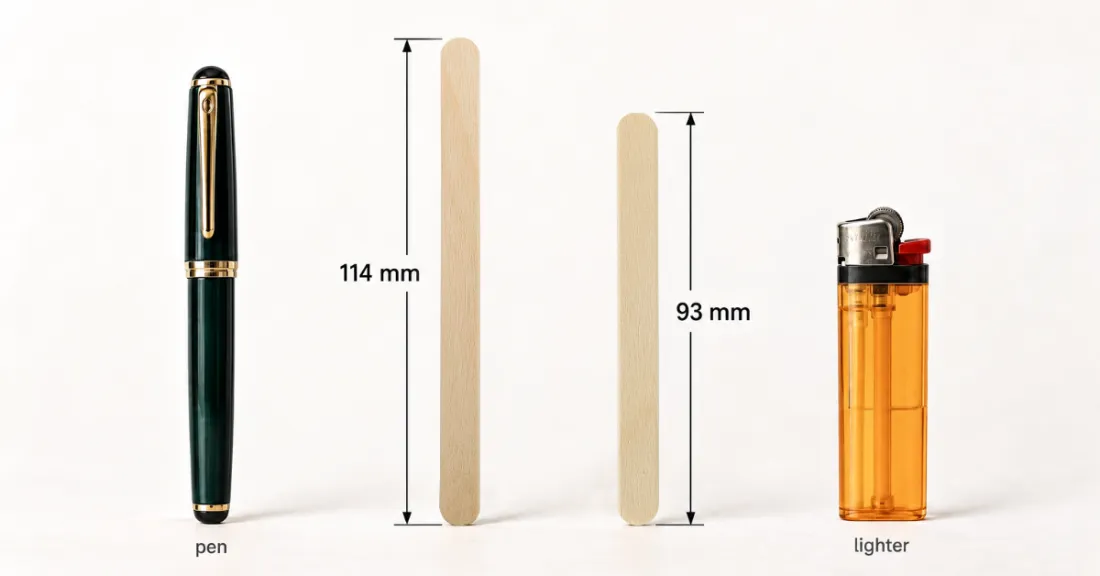
93 mm vs. 114 mm
- 93 mm (mini, 93 × 9.6 × 2 mm) suits children’s and mini ice creams and water-ice products.
- 114 mm (full-size, 114 × 9.6 × 2 mm) suits standard stick ice creams and popsicles.
Other lengths and thicknesses are available on request. See our 93 mm and 114 mm wooden ice cream sticks for full specifications.
Birch vs. Bamboo
Both are 100% natural, with no fillers, chemical treatment, or bleaching. Choose based on product design, brand positioning, your specification, and line-trial results. The material name alone does not guarantee compatibility with a high-speed inserter, so test the sticks you plan to buy.
Confirm Equipment Compatibility Before You Order
YADA Industrial’s sticks are specified for stick-insertion moulding lines including Tetra Pak, Gram Equipment, Technogel, Wuxi Danxiao, and Nanjing Shanlin, and for equivalent rotary and inline moulders, subject to specification and line-trial confirmation. To speed up the check, have these ready:
- Equipment brand and model
- Stick dimensions and tolerance requirements
- Target line speed and mould details
- Your trial requirements and acceptance criteria
Need a non-standard size? Our custom wooden and bamboo products explain what we can make to order.
12 How to Run a Sample Trial Before Bulk Ordering
A sample trial shows whether a stick specification works with your actual moulding line, not just whether the sticks look right on arrival. Before approving a bulk order, work through these steps:
- Confirm the specification.Record the stick length, width, thickness, material, and agreed straightness limits.
- Check the samples on arrival.Inspect a representative sample for visible warpage, dimensional variation, and rough edges.
- Run the samples under normal production conditions.Use the intended feeder, mould, and operating settings, and record the line speed and trial duration.
- Monitor feeding and insertion performance.Track misfeeds, insertion failures, stick-related stoppages, and any adjustments required.
- Compare the results with your acceptance criteria.Review the findings with your production team and supplier before approving bulk production.
A successful trial does not guarantee identical results across every future batch. Keep the approved sample and its specification as a reference for incoming inspection and repeat orders.
13 Storage and Handling: Protect Stick Quality After Delivery
Even sticks that met the agreed specification at shipment should be protected from moisture exposure, condensation, and unsuitable storage conditions. YADA Industrial packs sticks in sealed food-grade PE bags inside export cartons, and that packaging does its job best when left intact until the sticks are needed. For production teams:
- Store cartons in a clean, dry area and follow the supplier’s storage recommendations.
- Keep packaging intact until the sticks are needed for production.
- Avoid sudden environmental changes that may cause condensation.
- If a batch has been stored under unusual conditions, inspect it before feeding it into the line.
If feeding problems appear after a period of storage, compare the affected batch with a properly stored reference batch before concluding that the original manufacturing specification was the cause.
14 A Buyer’s Checklist for Jam-Resistant Ice Cream Sticks
Before you request a quote, ask any supplier the six questions below. They cover tolerances, inspection, records, trial samples, and supply stability, and the answers help you compare suppliers on the same basis.
| Question to ask | Why it matters |
|---|---|
| What are your straightness limits for curve, zig-zag, and banana? | Sets a clear acceptance standard for each type of deformation |
| How is each stick inspected, and for which defects? | Shows what the inspection actually covers |
| Do you provide batch-level COA records? | Lets you verify consistency lot by lot |
| What are your dimensional tolerances? | Helps you match sticks to your insertion system |
| Can you provide samples for line trials? | Confirms compatibility before mass production |
| Can you support repeat bulk orders? | Indicates long-term supply stability |
You can see how our own inspection works on our quality inspection page.
15 Frequently Asked Questions About Ice Cream Stick Jams
How do you prevent ice cream stick jams on high-speed lines?
Start by verifying stick straightness, dimensional consistency, and surface quality against tolerances you have agreed in writing. Work with a supplier that provides batch-level inspection records, and run a line trial before approving bulk orders. Also check machine-side factors such as feeder condition and alignment.
Why do wooden ice cream sticks jam in automatic insertion machines?
Warped sticks, inconsistent dimensions, and burrs can interfere with feeding and insertion. Worn feed channels, feeder settings, mould alignment, and insertion timing can also contribute, so both the sticks and the machine should be checked.
What straightness tolerance should I specify?
Specify measurable limits that match your equipment and acceptance criteria, for each deformation type. YADA Industrial's specification lists curve ≤ 2.8 mm, zig-zag ≤ 2.8 mm, and banana ≤ 10.4 mm, recorded per lot on the COA. Confirm the measurement method with any supplier you compare.
Can wooden ice cream sticks be used on a 48,000-sticks-per-hour line?
Wooden sticks can be used in high-speed moulding applications, but compatibility depends on stick dimensions, straightness tolerances, feeder design, and operating conditions. YADA Industrial supplies 93 mm and 114 mm birch and bamboo sticks for high-speed applications. Confirm compatibility with your specific machine model and complete a production-line trial before bulk approval.
Does optical sorting help reduce stick jams?
Optical sorting can identify and reject sticks outside defined tolerances before they reach your line, which reduces the risk from warped or inconsistent sticks. It cannot remove every possible cause of a jam, so machine-side conditions still need checking.
What should I request from a wooden ice cream stick manufacturer?
Request a technical specification sheet, straightness and dimensional tolerances, batch-level COA records, material and food-contact documentation, and samples for a line trial.
16 Your Next Step: Check the Sticks Alongside the Machine
If your line is having stick-related feeding problems, checking stick quality alongside machine conditions can help you narrow down the cause before your next production run.
If you’re evaluating wooden or bamboo ice cream sticks for a high-speed line, YADA Industrial can help you review specifications and arrange samples for compatibility testing. Share your machine model, required stick dimensions, and target line speed, and we’ll help you identify what to verify before ordering in bulk.