What is the difference between birch wood and bamboo popsicle sticks in durability and cost?
- Share
- Issue Time
- Jul 30,2026
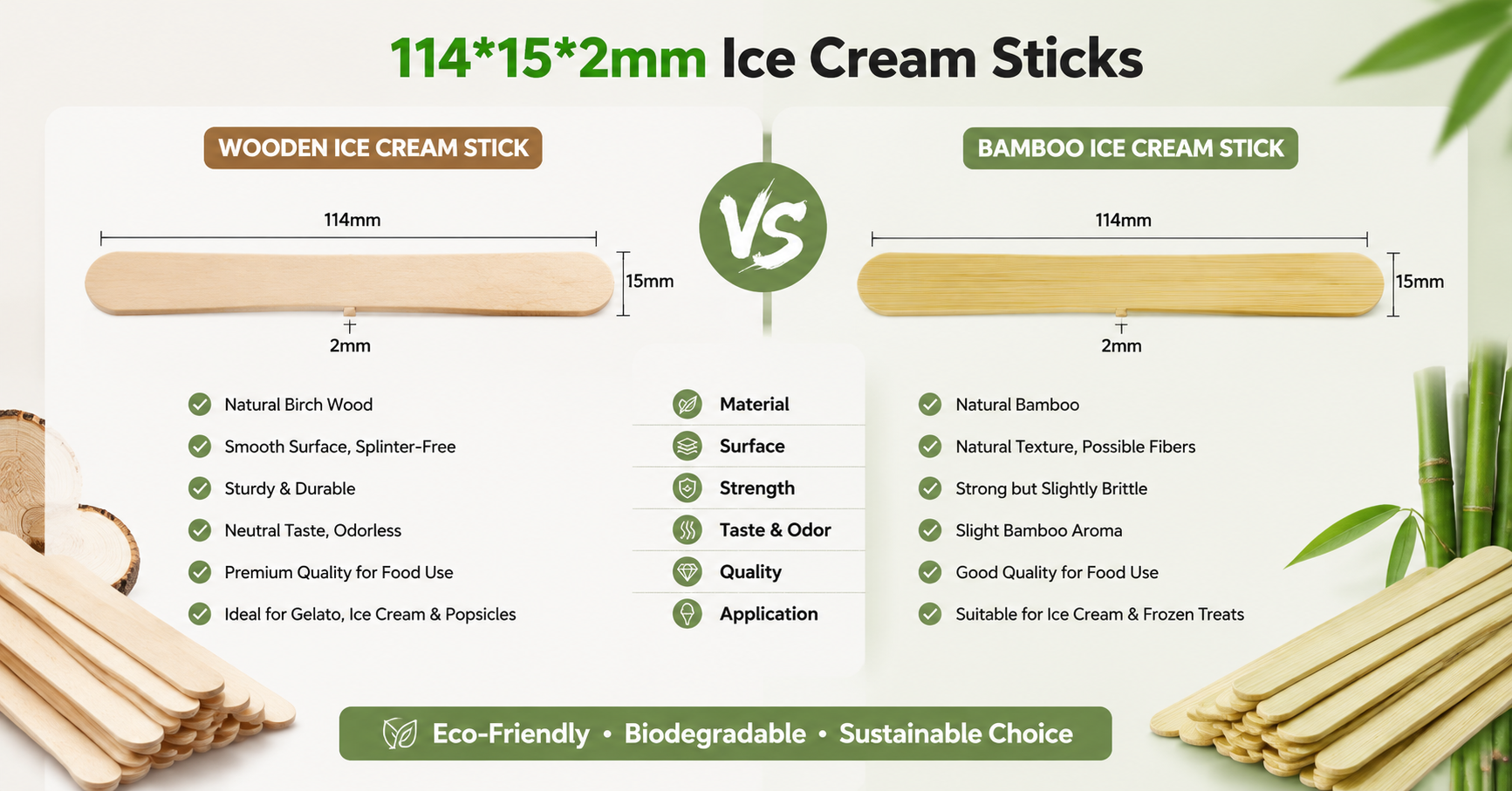
Birch wood popsicle sticks are the industry standard for cost-efficiency and balanced durability, typically costing $3 to $4 per 1,000 units. Bamboo popsicle sticks offer superior bending strength and splinter resistance but cost $5 to $6 per 1,000 units. For high-volume wholesale ice cream sticks and spoons programs, birch wood remains the optimal balance of performance and price; for premium or sustainability-positioned brands, bamboo justifies its premium with measurably greater break resistance and a greener market image. Both birch wood and bamboo serve as food-grade stick materials for frozen desserts, but their mechanical properties, manufacturing processes, and supply economics differ in ways that directly affect procurement decisions for wholesale buyers. Birch is a dense hardwood with a fine, uniform grain. Logs are steam-softened, rotary-peeled into thin veneer sheets, and die-cut into stick shapes at high speed. This mature, highly automated process delivers consistent dimensional accuracy, neutral taste, and smooth, splinter-free surfaces. Birch sticks provide adequate flex for standard frozen dessert applications and maintain structural integrity at freezer temperatures. Bamboo is a fast-growing grass with naturally aligned fibers that provide exceptional tensile strength. Bamboo stalks are split, sliced into thin boards, shaped, and polished through additional processing steps beyond what birch requires. The result is a stick with significantly higher bending strength and a distinct natural grain pattern. However, the extra manufacturing complexity translates to a higher per-unit cost compared to birch. YADA Industrial operates a dual-material production capability serving ice cream manufacturers across multiple international markets. A common procurement pattern observed among clients is to deploy birch wood sticks for high-volume standard lines where cost efficiency is the priority, while reserving bamboo sticks for premium or organic product ranges where the material's higher strength and distinct natural appearance provide market differentiation. This dual-source strategy lets brands optimize procurement cost on volume SKUs while differentiating premium lines through material choice. YADA Industrial routinely advises wholesale ice cream sticks and spoons buyers to evaluate both materials against their specific product requirements and target retail positioning before committing to a single-material bulk order. The table below summarizes the key differences buyers should consider when evaluating birch wood versus bamboo popsicle sticks. Need to compare birch and bamboo sticks in your own production line? Contact YADA Industrial for free samples and a tailored quotation based on your order volume and target market requirements.Detailed Explanation: Birch vs Bamboo Material Differences
Birch Wood Popsicle Sticks
Bamboo Popsicle Sticks
Industry Practice: YADA Industrial Dual-Material Supply Approach
Side-by-Side Comparison
Property
Birch Wood
Bamboo
Bending strength
Moderate, adequate for standard frozen desserts
Significantly higher, better for hard-frozen or heavy products
Splinter resistance
Excellent when properly sanded and polished
Good; surface requires thorough finishing due to fibrous grain
Moisture absorption
Moderate; performs well under normal frozen storage conditions
Lower absorption rate; maintains integrity longer in high-humidity environments
FOB cost per 1,000 units (USD)
$3.00 – $4.00
$5.00 – $6.00
Production throughput
Higher; established high-speed cutting and polishing lines
Lower; additional splitting and finishing steps reduce line speed
Raw material sustainability
Harvested from managed forests; regrowth takes decades
Renewed in 3 to 5 years per crop cycle
Food-grade certification
FSC, BRC, FDA
FSC, BRC, FDA
Custom embossing/printing
Supported on smooth, flat surface
Supported; denser surface holds finer detail