Wooden Ice Cream Sticks Food Safety: A Buyer's Guide to Testing & Compliance
- Share
- publisher
- YADA Industrial
- Issue Time
- Sep 17,2026
Summary
Natural wood is not automatically food-safe. This buyer's guide covers the sourcing, moisture, hygiene and testing controls that make wooden ice cream sticks suitable for food contact, how FDA and LFGB requirements actually work, and the documents and sample checks to complete before you place a bulk order.
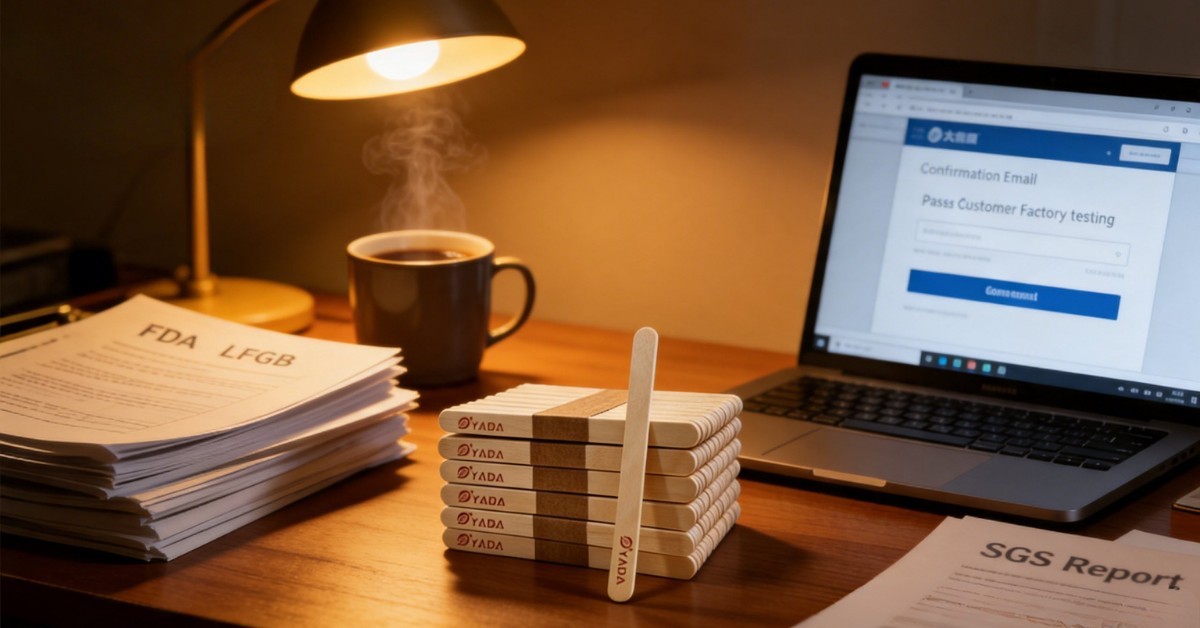
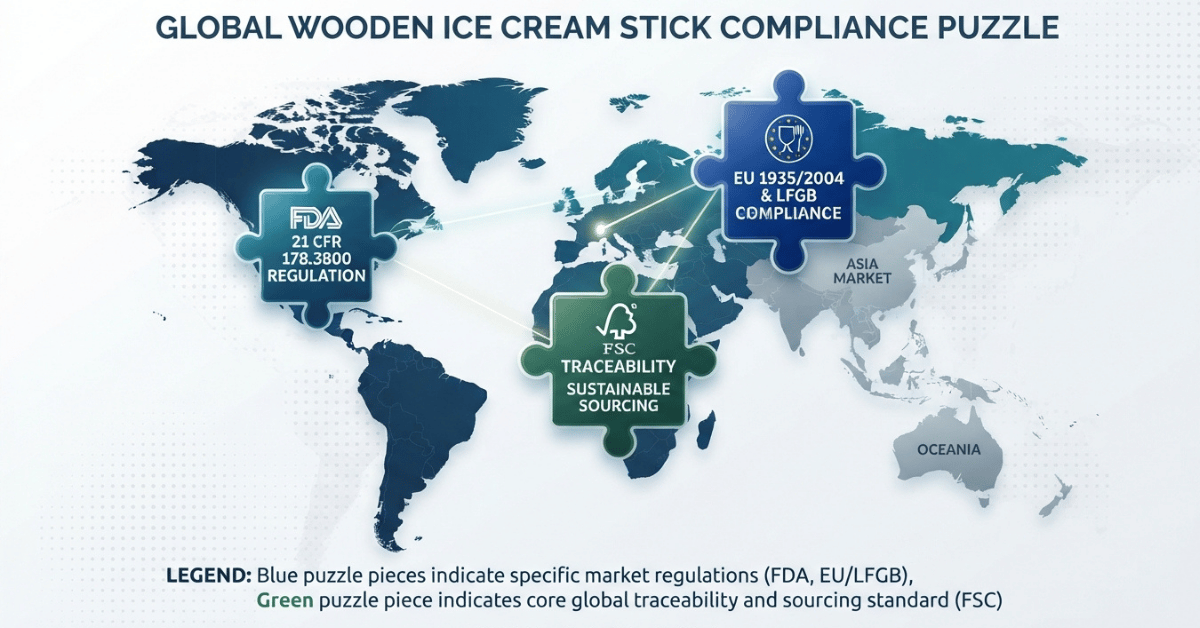
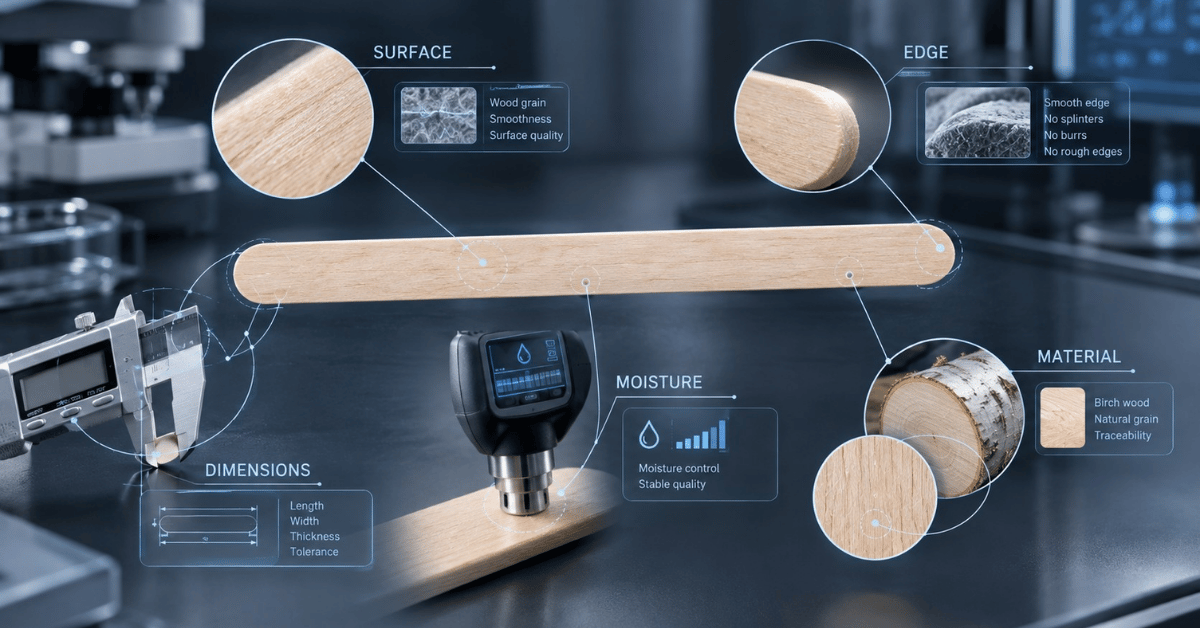
If you're sourcing wooden ice cream sticks, you're probably not asking whether wood is a "natural" material — you already know that part. What you actually want to know is narrower: how do you confirm that this stick, from this factory, is genuinely safe to end up in your customer's mouth? In this guide Quick answer: Wooden ice cream sticks can be food-contact safe for your production line, but that depends on the specific product you're buying, not the material category as a whole. You get that safety from verified wood sourcing, controlled moisture and processing, hygienic manufacturing, and product-specific test results covering microbiological, chemical migration, and sensory checks — not from claims like "natural," "FDA," or "LFGB" taken at face value. Before you order, ask for test reports and documentation tied to the exact product, size, and batch you intend to buy. Natural isn't the same as food-safe, and it's worth keeping that distinction in mind as you evaluate suppliers. A piece of birch straight off the sawmill floor is natural, but it hasn't been dried to a stable moisture level, hasn't been screened for insect holes or mineral staining, hasn't passed through a controlled production line, and hasn't been tested for anything. None of that happens automatically just because the raw material is wood rather than plastic. You're also holding this product to a stricter standard than most other wooden items, whether you've thought of it that way or not — because it isn't decorative or occasional-use. It sits in direct contact with a frozen food product, it's usually held in the mouth, and on your production line it functions as a mechanical component that has to survive automatic filling and freezing without splintering, warping, or jamming your machine. So the real question you should be asking a supplier isn't "is this made of natural wood?" It's "was this specific product manufactured and controlled for food-contact use, and can you prove it to me?" Food safety in this category comes from several separate controls, applied consistently across every batch. Here's what you should be looking at, and what each one actually tells you as a buyer. Most commercial ice cream sticks are made from birch, with bamboo available if you want a bamboo-specific sustainability story for your own brand. Birch is favored less for marketing reasons than practical ones: it has a fine, largely knot-free grain, machines cleanly into thin veneer, and takes a smooth finish without coatings or bleach. None of that tells you anything about the specific shipment you're about to order, though. What you actually need at the sourcing stage is traceability — which forest the wood came from, whether it's certified under a recognized scheme such as FSC, and whether incoming logs are checked before they reach the line. Before you commit to a new supplier, ask directly which wood species they use and how consistent it is across runs, where they source it and whether that sourcing is certified, and whether the material is specifically rated for food-contact use rather than general-purpose lumber. Moisture content needs testing at more than one point, because it fails in two directions and either one becomes your problem down the line. Too much moisture and your finished stick can warp, crack, or become a mold risk in storage. Too little, and it turns brittle and prone to snapping mid-use — right in front of your customer. You want a supplier who measures moisture at intake, after drying, and again on finished product — not one who treats "dry" as good enough on its own. Here's roughly what happens before a stick ever reaches your hands: birch logs are typically steamed before cutting, which softens the wood for cutting, loosens the bark for removal, and reduces surface bacteria as a side effect of the heat exposure. The steamed logs are sliced into veneer sheets and die-cut into stick blanks, which go through high-temperature drying to bring moisture down to a stable level. From there, blanks are polished to remove splinters and rough edges, pressed into final shape, and — on many lines — passed through a UV exposure step before a second, finer polish removes residual dust. It's worth being precise about what these steps do and don't prove for you as a buyer. Steaming, drying, polishing, and UV exposure all contribute to hygiene and dimensional stability, and they reduce contamination risk as a byproduct of processing. But they're process controls, not a substitute for a finished-product test report — so if a supplier tells you their sticks are safe "because they're steamed and UV-treated," ask for the test report anyway. That's what actually proves the outcome to you. Surface quality matters directly to you and your customers, too: since the stick is held and often bitten near the tip, splinters and rough grain are the most common real-world complaint you're likely to hear about — which is exactly why two polishing passes plus automated defect sorting exist. If you're assessing a factory, don't let a clean workshop stand in for the whole picture — it's one part of a broader hygiene-control system, not a certification in itself. A classified clean room — often described by particle-count class, such as a 100,000-class environment — limits airborne particulates and is typically paired with automated handling that reduces direct hand contact during forming and packaging. If you're reviewing a factory audit, look beyond the room-class number: GMP and BRCGS audits assess facility hygiene, personnel practices, equipment condition, process controls, and traceability records. The cleanroom rating is a useful data point, but the audit scope behind it will tell you a lot more. Batch-level microbiological testing typically checks for total bacterial count and Staphylococcus aureus, both used to flag contamination risk before a batch ships to you. Ask for this to be run through a third-party lab, so you're not relying on an internal claim alone. This is the piece you'll want documentation for, not just a verbal assurance. It covers formaldehyde and sulfur dioxide migration, pentachlorophenol (PCP) content, and residue checks for substances such as thiram, o-phenylphenol, myclobutanil, and biphenyl — all measured against the applicable limit values for your market. Sensory evaluation is usually bundled in here too: a trained check that the surface is clean, the texture is smooth, the odor is neutral, and the packaging is still intact by the time it reaches you. Even a well-tested stick can pick up contamination or damage after it leaves the production line if packaging and shipping aren't controlled — and that risk is entirely avoidable if you confirm it up front. You'll want cartons inspected before loading, shipping containers checked for cleanliness, and product palletized or container-loaded in a way that protects it in transit. Confirm your packaging specification up front — bundle packs, bulk bags, or cartons — since inadequate packaging is a common, avoidable cause of contamination or breakage that has nothing to do with how well the stick itself was made. If you're buying for the U.S. market, know this going in: there's no single FDA "certification" that automatically makes a wooden ice cream stick food-safe. FDA regulation of food-contact materials works substance by substance and use by use, so you'll want to confirm that the specific material, any additives or treatments, and the intended food-contact use are covered by the applicable FDA requirement — rather than accepting a general "FDA certified" claim at face value. For wood products specifically, one relevant regulation is 21 CFR Part 178.3800, which governs the use of pentachlorophenol (PCP) as a wood preservative. This matters to you because most commercial ice cream sticks are unbleached and untreated, and you'll want assurance that the finished product falls within — or entirely outside — the limits this regulation sets. It's a narrow, substance-specific rule, though, not a blanket "FDA-approved wooden ice cream stick" standard, so don't let a supplier present it to you as one. What you should ask for documentation that cites the specific FDA requirement being claimed, tied to the actual product and batch you're buying — not a general compliance statement with no regulation named. If you're buying for Germany or the wider EU, here's what you're actually looking at. LFGB is Germany's Food and Feed Code (Lebensmittel- und Futtermittelgesetzbuch), and it's commonly used as the reference framework for testing and conformity assessment when a supplier is targeting German or broader European buyers. It isn't itself the EU-wide legal basis for food-contact materials, though — that role belongs to EU Regulation (EC) No 1935/2004, which sets the general framework that food-contact articles sold into the EU need to satisfy. In practice, LFGB-referenced testing for wooden items typically includes a migration test for formaldehyde (§30) and a formal sensory panel evaluation for off-tastes or off-odors (§31), along with checks for pentachlorophenol content and, where a "BPA-free" claim is made, verification of total Bisphenol-A content. Here's why the distinction matters for you: an LFGB test report shows you that a product passed specific, named tests. That's useful, verifiable evidence — but it isn't automatically the same as a guarantee that a product satisfies every EU member state's own food-contact requirements, some of which layer additional national rules on top of the general EU regulation. If you're selling into more than one EU country, it's worth asking your supplier directly whether they've considered this. Don't accept "FDA and LFGB certified" as a self-contained answer. Ask which specific test, which regulation section, which lab, and which batch or product line the report actually covers — you're entitled to that level of detail before you send a deposit. Here's a simple list you can send straight to a supplier and ask them to work through: Paper specifications only go so far — a physical check catches things a data sheet won't, and it only takes you a few minutes. If you want to see what this looks like in practice rather than in the abstract, here's the process behind YADA Industrial's own ice cream sticks, from raw material to the carton you'll eventually open: According to YADA Industrial's current certification and testing records, this is backed by ISO 9001:2015, BRC, GMP, and Sedex certification, alongside FSC chain-of-custody documentation and SGS-verified test reports covering the checks above, in addition to FDA- and LFGB-referenced documentation for its wood and bamboo product lines. If you want to see this for yourself, full certificate and test-report details are maintained on YADA Industrial's certificate page. On scale: YADA Industrial has been manufacturing wooden and bamboo disposable tableware since 1996, and operates three production bases — in Dalian, in Fujian, and overseas — across roughly 60,000 m² of factory space, including a 3,000 m² clean workshop rated to a 100,000-class standard. Raw material sourcing draws on more than 666 hectares of managed birch and bamboo forest feeding into FSC-traceable production. Per its own published materials, YADA Industrial's ice cream sticks and eco-friendly cutlery are used by global brands including Nestlé, and the company reports serving more than 500 buyers across Europe, Southeast Asia, the Americas, the Middle East, and Oceania. Practically, that means you're not choosing between "cheap and unreliable" or "safe but slow" — you get factory-direct pricing along with the documentation and consistency your bulk order actually needs. You can choose from straight-edge and bevelled-edge profiles at 93mm and 114mm, plus wider "magnum" profiles at 72mm, 93mm, and 94mm. Minimum order quantities start at 10,000 pieces. If you want your own branding on the stick itself, custom hot stamping or laser engraving — on single or double sides — is available, along with custom packaging, so you can build your own brand into the product rather than shipping a blank stick. When you're evaluating a new supplier, you should: A wooden ice cream stick looks like a small, simple thing, and in daily use it is. But getting it safely from a birch forest to a spoonful of frozen dessert depends on a full chain of decisions: which wood, how it's dried, how clean the workshop is, what gets tested, and whether the paperwork behind an FDA- or LFGB-related claim actually matches the product in front of you. If you ask about that chain — not just the species of wood — you're the buyer who avoids surprises after the container has already shipped. Looking for food-safe wooden ice cream sticks for your next production run? Get in touch with YADA Industrial and they'll walk you through specifications, samples, and bulk order requirements. Yes, they can be suitable for food-contact use when they're manufactured under controlled sourcing, hygiene, and testing practices. "Wooden" or "natural" alone doesn't get you there, though — you'll want to verify product-specific test reports rather than relying on the material description. At minimum, look for microbiological testing (total bacterial count, Staphylococcus aureus), chemical migration and residue testing (formaldehyde, sulfur dioxide, pentachlorophenol, and related substances), sensory evaluation, and dimensional and moisture testing. Depending on your destination market, you may also need FDA-referenced or LFGB-referenced testing on top of that. There's no single "FDA certification" that applies to this product as a category. What you should check instead is the applicable FDA requirement for the specific material and use — for treated wood, that often means 21 CFR 178.3800, which governs pentachlorophenol use in wood preservatives. Ask your supplier which specific requirement their claim refers to. Not automatically. LFGB is Germany's Food and Feed Code and is commonly used for testing aimed at the German market. If you're selling elsewhere in the EU, general food-contact compliance is governed by EU Regulation (EC) 1935/2004, and individual member states can add their own national requirements on top. Treat an LFGB report as strong evidence, not a guarantee that covers every EU country. At minimum, ask for a product specification sheet, a food-contact test report specific to the item and batch, a microbiological test report, chemical migration results, FSC or equivalent traceability documentation, and relevant factory certifications such as ISO 9001, BRC, GMP, or Sedex. Neither is inherently "better" for you — they're different materials with different properties. Birch is prized for its fine, knot-free grain and clean machining; bamboo is worth choosing if you want a bamboo-specific sustainability story for your own customers. Food safety depends on sourcing, processing, and testing regardless of which species you pick. Common commercial sizes include 72mm, 93mm, 94mm, and 114mm, in straight-edge, bevelled-edge, and wider "magnum" profiles. Dimensional tolerance matters as much as length here, since automated filling equipment is sensitive to inconsistent stick dimensions. Dalian Yada Industrial Co., Ltd. (YADA Industrial) is a manufacturer — not a trading company — of wooden and bamboo disposable products, operating since 1996 across three production bases in Dalian, Fujian, and overseas. Full company background is available on YADA Industrial's About page. Reviewed against YADA Industrial's current product and certification documentation. Last updated: September 2026.Key Takeaways for Buyers
What Makes a Wooden Ice Cream Stick Food Safe?
Key Food Safety Controls You Should Expect From a Supplier
1. Raw Material & Traceability
2. Moisture Control
3. Processing & Surface Quality
4. Hygienic Production
5. Microbiological Testing
6. Chemical & Migration Testing
7. Packaging & Storage
FDA Compliance for Wooden Ice Cream Sticks
LFGB and EU Food-Contact Compliance
FDA vs. LFGB: What You Should Actually Verify
What you're checking U.S. market Germany / EU market Regulatory basis Applicable FDA food-contact requirements EU Regulation (EC) 1935/2004; LFGB commonly used for German-market testing Wood preservatives Ask about applicable requirements, including 21 CFR 178.3800 where relevant Verified through LFGB PCP content testing Chemical migration Verify against applicable food-contact requirements for your intended use §30 LFGB: specific migration test for formaldehyde Sensory properties Assessed as part of general food-contact suitability §31 LFGB: formal sensory panel evaluation Label claims (e.g. "BPA-free") No dedicated FDA test category for this product type Verified via total Bisphenol-A content testing What to request Documentation citing the specific FDA requirement and product/batch Test report citing §30/§31, PCP result, and the batch tested 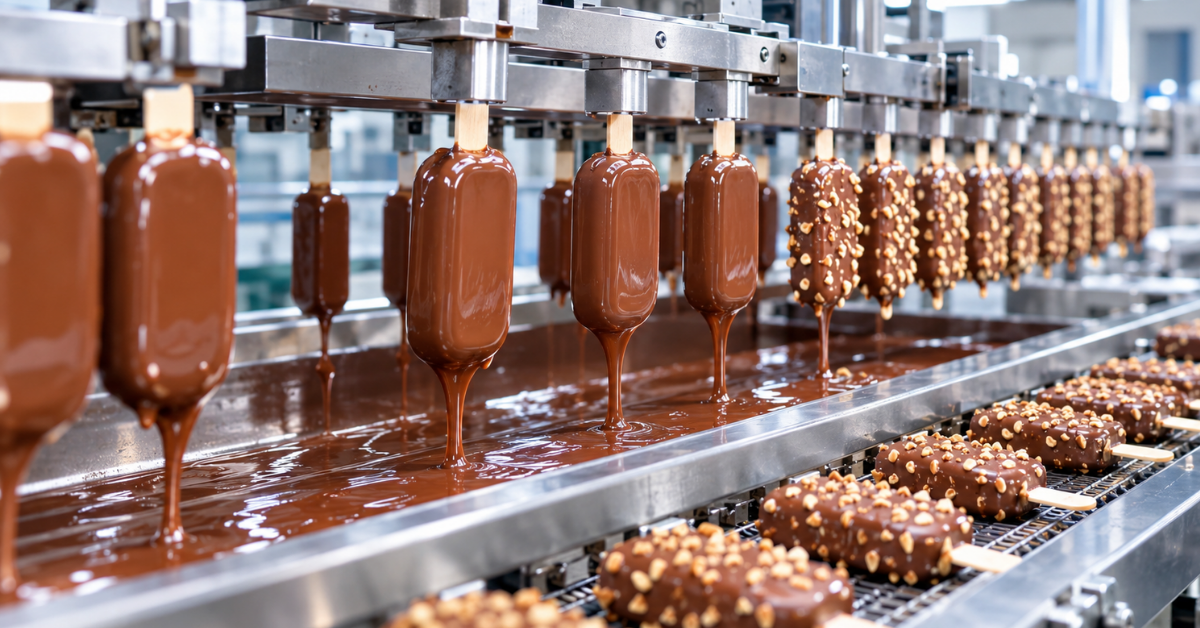
Common Misconceptions That Can Cost You Time or Money
Documents You Should Request Before Ordering
Document Why it matters to you Product specification sheet Confirms size, material, and tolerance match what you need Food-contact test report Verifies safety parameters relevant to your destination market Microbiological test report Gives you evidence of microbial control at the batch level Chemical migration report Backs up the food-contact compliance claim you're relying on FSC or equivalent traceability documentation Supports any sustainability story you want to tell your own customers Factory certifications (ISO, BRC, GMP, Sedex, etc.) Helps you assess manufacturing and hygiene controls without visiting the factory yourself Sample approval record Confirms actual product quality before mass production starts Packaging specification Helps you control contamination and damage during shipment 
How to Inspect Wooden Ice Cream Stick Samples Yourself
How YADA Industrial Controls Wooden Ice Cream Stick Quality
Wooden Ice Cream Stick Sizes & Custom Options
Supplier Evaluation & Pre-Order Checklist
Pre-Order Checklist: What to Confirm First
From Forest to Frozen Dessert
Frequently Asked Questions
Are wooden ice cream sticks food safe?
What tests should wooden ice cream sticks pass?
Do wooden ice cream sticks need FDA certification?
Does LFGB certification mean a wooden ice cream stick is safe for all EU markets?
What documents should I request from a wooden ice cream stick supplier?
Is birch better than bamboo for ice cream sticks?
What sizes are available for automatic ice cream production lines?
About YADA Industrial