EUDR for Wooden Cutlery: Supplier Verification Guide for EU Buyers
- Share
- Issue Time
- Sep 3,2026
Summary
A practical EUDR guide for procurement teams sourcing wooden cutlery for the EU market: 10 supplier questions, FSC vs EUDR comparison, 7-point evaluation framework, red flags, and a pre-order checklist.
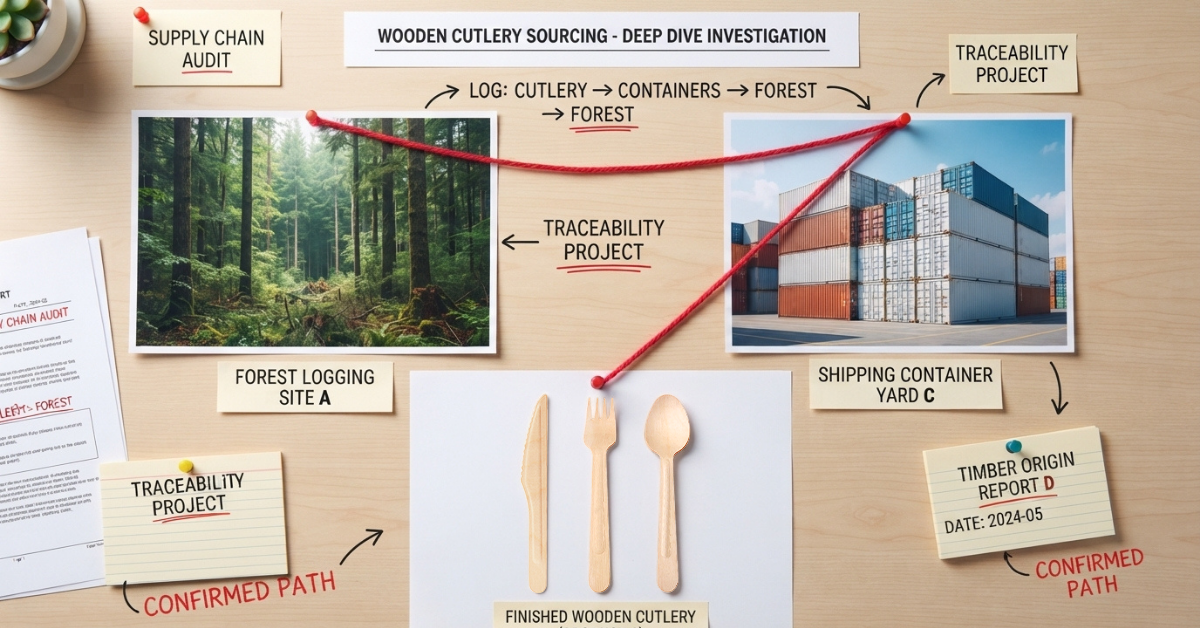
A practical guide for EU importers, distributors, foodservice suppliers, and purchasing managers. If you are sourcing wooden cutlery for the EU market, the questions your compliance team asks have changed: where the wood actually came from, whether that can be proven, and whether that answer stays stable from your first order to your fifth. This guide covers what to actually ask a wooden cutlery supplier before you commit. Read this first: This guide is not a substitute for legal advice. Confirm your specific obligations with your own compliance team or legal counsel, and always check the European Commission's official EUDR pages for the current position — the timeline and requirements have already been revised more than once. The core shift: EUDR turns supplier selection into a supply-chain verification decision — not simply a product sourcing decision. The EU market's expectations around supply-chain transparency for wood-based products have moved quickly, and wooden cutlery — often treated as a "simple" disposable product — falls squarely within that shift. For procurement teams, the sourcing conversation now includes questions that used to sit outside the buying process entirely: Where does the raw material actually come from? Can that be traced back with confidence? What documentation can the supplier actually produce, not just promise? And does that information stay consistent on your third or fourth repeat order? None of this replaces the fundamentals you already evaluate — quality, pricing, capacity, and lead time still matter as much as ever. But for EU-bound orders, they are no longer the whole picture. A supplier that looks strong on all four, yet has no clear answer on raw-material traceability, represents a different kind of risk than it did a few years ago. EUDR is the EU Deforestation Regulation — Regulation (EU) 2023/1115. Relevant products placed on, sold within, or exported from the EU market must be produced without contributing to deforestation or forest degradation, and operators must carry out due diligence to demonstrate this before the products enter the EU. Cattle, cocoa, coffee, palm oil, rubber, soy, and wood — plus a defined list of products made from them. Wood-based tableware, the category wooden cutlery falls under, is included in that product list. "Deforestation-free" means the wood did not come from land deforested or degraded after the regulation's cutoff date. Due diligence means assessing and mitigating risk — collecting geolocation data on where the raw material was produced, assessing risk, and submitting a due diligence statement before the product enters the EU market. The application date has been postponed twice since adoption. As of this writing, large and medium operators face the main obligations from 30 December 2026, with a grace period for micro and small enterprises until 30 June 2027, under the most recent amending regulation. Verify the current date directly on the European Commission's EUDR pages. Rather than working through the regulation clause by clause, think in terms of the practical chain of information a buyer needs from a supplier: Material Origin Traceability Geolocation Due Diligence Documentation Each step feeds the next. You cannot produce meaningful documentation without traceability, and you cannot have traceability without a clear record of material origin in the first place. When you evaluate a supplier, test this chain — not just whether they say "yes" to compliance in general, but whether they can walk you through each link. Not the same answer as wood. Bamboo is botanically classified as a grass, not a tree, and EU regulatory guidance follows the FAO classification of bamboo as a "non-wood forest product." Based on the Commission's published FAQ guidance and its draft rules on product scope, products made solely from bamboo currently fall outside the "wood" commodity definition that triggers EUDR due diligence. Two cautions: the classification applies to products made entirely from bamboo — a product combining bamboo with an actual wood component may still need the wood portion assessed separately. And because this area is being actively clarified, buyers sourcing bamboo should confirm the current classification for their specific product and HS code rather than assume this summary will still be accurate when they read it. Do not assume "wood and bamboo" belong in the same EUDR conversation — they currently do not. This is the core of the guide. For each question, we break out why it matters, what to ask, what a weak answer sounds like, and what a strong one sounds like — so you can use this section as an actual call script, not background reading. Why it matters: This is the foundation everything else in the chain depends on. What to ask: Wood species, country or region of origin, name of the raw-material supplier, and whether that source stays consistent order to order. Red flag: "Our materials are sourced from reliable suppliers." What good looks like: "Here is the species, the region, our raw-material supplier, and how long we have worked with them." Why it matters: Traceability turns a sourcing claim into something verifiable. What to ask: How raw-material information actually moves through the supply chain — from source, through processing and manufacturing, to the finished product. Red flag: "We trust our upstream partners." What good looks like: A specific, step-by-step explanation of how a batch of raw material is recorded and connected to what it eventually becomes. Why it matters: Geolocation is more granular than a country-of-manufacture label. What to ask: What location-level information about the raw material itself — not the factory — the supplier can actually provide. Red flag: Treating "Made in China" as if it answers the question. What good looks like: A clear, honest answer about what geolocation data is currently available and what is not yet. Why it matters: FSC certification is a meaningful signal of responsible forestry, but it answers a different question than EUDR — see Section 4. What to ask: Certificate number, issuing body, and scope of the certification — which products and facilities it actually covers. Red flag: "We're FSC certified, so EUDR is covered." What good looks like: A supplier who explains FSC certification and EUDR readiness as two separate, complementary things. Why it matters: Documentation that cannot be connected to your actual order is not useful documentation. What to ask: How raw-material batch, production run, and shipment records link together for a specific PO. Red flag: Documentation exists somewhere, but no one can show how it maps to your order. What good looks like: A supplier who can walk a specific order back through the chain, batch by batch. Why it matters: One of the most revealing questions — and one buyers often skip. What to ask: What happens when the supplier switches wood source — due to cost, availability, or a new subcontractor — and whether that change is recorded and re-reviewed. Red flag: The supplier cannot explain what happens when raw-material sources change. What good looks like: A defined process for recording the change, re-verifying the new source, and updating documentation accordingly. Why it matters: A clean sample does not guarantee a clean fifth repeat order six months later. What to ask: Whether sourcing and documentation standards hold steady across the full arc — sample, trial order, mass production, repeat orders. Red flag: Compliance answers are strong for the sample but vague for ongoing production. What good looks like: Evidence — or at least a clear process — for maintaining the same standard order after order. Why it matters: Traceability and product quality should reinforce each other, not sit in separate conversations. What to ask: How raw-material inspection, in-process control, finished-product inspection, and documentation management connect. Red flag: Strong QC claims with no mention of how documentation fits in — or vice versa. What good looks like: A single, integrated explanation of how quality and traceability are managed together. Why it matters: When your compliance team needs to act, responsiveness matters as much as any single document. What to ask: Whether the supplier can provide documentation, product and raw-material information, and traceability records promptly when your due-diligence process requires them. Red flag: Compliance answers are always verbal, never documented. What good looks like: A named contact or process for exactly this kind of request. Why it matters: The real question is not whether a supplier can pass one well-prepared order — it is whether they can sustain this over years of purchasing. What to ask: Whether the supplier can scale with your volume, keep documentation consistent as orders grow, manage OEM/ODM requirements alongside these expectations, and maintain stable raw-material sourcing over time. Red flag: The supplier promises "100% EUDR compliant" without explaining how. What good looks like: A grounded, specific answer about what is already in place and what the supplier is still building toward. These two are frequently conflated, and that confusion can lead buyers to treat one as a substitute for the other. They are related, but they answer different procurement questions: FSC certification and EUDR due diligence are complementary, not interchangeable. FSC gives buyers a meaningful signal about a supplier's forestry practices and chain-of-custody controls. It does not, on its own, satisfy the geolocation, risk-assessment, and due-diligence-statement requirements EUDR introduces. A thorough evaluation checks for both, rather than assuming one implies the other. It is tempting to evaluate a supplier by the finished product in front of you — how it looks, feels, and how consistent the batch is. But finished-product quality alone cannot tell buyers enough about the upstream supply chain that produced it. Real traceability starts at the raw-material stage and carries through every step that follows: Raw Material Sourcing Material Processing Manufacturing Quality Control Packaging Export A supplier who only has strong answers about the final two or three steps — manufacturing quality, packaging, export logistics — but a vague answer about the first two has a gap that shows up exactly where EU due diligence looks hardest. This is a question most buyers genuinely are not sure about: is this the supplier's problem, or mine? Generally expected to provide the underlying information — material origin, geolocation, supporting documentation — that an EU operator needs to complete due diligence. The supplier itself is not usually the one submitting a due-diligence statement to EU authorities. The company first placing the product on the EU market generally carries the legal due-diligence obligation under EUDR: assessing risk, collecting the required information, and submitting the due-diligence statement. May have lighter, but still relevant, obligations depending on their role and size. This is one area the regulation's ongoing simplification process is actively revising — confirm current guidance for your specific role. Important: Supplier support does not automatically transfer the buyer's legal responsibility. A cooperative, well-documented supplier makes your due-diligence process considerably easier — but if you are the EU operator placing the product on the market, the compliance obligation is generally still yours to fulfill. Pulling the questions above together, here is a practical model for scoring any supplier against this specific set of concerns. Rate each supplier 1–5 on every point — it turns a vague impression into something comparable across your shortlist: 1Material Transparency — Is the source of the wood clearly identified and consistently communicated? 2Traceability — Can the supplier actually trace material from source through to finished product, not just describe the concept in general terms? 3Documentation — Can the supplier produce documentation that connects to specific products, batches, and shipments? 4Certification — Does the supplier hold relevant certifications like FSC, understood as one input among several rather than a complete answer? 5Manufacturing Control — Is there a stable, documented production system behind the product, not an ad hoc process? 6Supply-Chain Stability — Can the supplier maintain the same standard of sourcing and documentation order after order, not just for a single well-prepared sample? 7EU Export Experience — Does the supplier understand the practical requirements of international, EU-bound procurement, from documentation to communication? A supplier who scores well across all seven points is in a fundamentally different category than one who scores well on manufacturing and export experience alone. Gathered from the questions above, here is the short version — the answers worth being genuinely cautious about when you hear them: "We are FSC certified, so EUDR is covered." "The wood is from China" — with no further origin information offered. The supplier cannot explain what happens when raw-material sources change. Documentation exists, but no one can connect it to your specific order. The supplier talks confidently about finished-product quality but avoids upstream sourcing questions. Compliance answers are always verbal, never documented in writing. The supplier promises "100% EUDR compliant" without being able to explain how. None of these are automatic disqualifiers on their own — but more than one or two together is a reasonable signal to keep looking, or at minimum to ask harder follow-up questions before committing to volume. Rather than a general company introduction, this section maps directly onto the questions from Section 3 — what YADA INDUSTRIAL can actually offer against each one, and where buyers should verify further for their specific order: One point worth stating plainly: This guide deliberately avoids claiming that YADA INDUSTRIAL — or any supplier — is simply "EUDR compliant" as a blanket statement. Compliance depends on the specific product, documentation, and role of each party. If you are sourcing for the EU market, the right next step is a direct conversation about what YADA INDUSTRIAL can document for your specific product and order. Before you place an order, ask your supplier: Save or screenshot this list — it is meant to be the actual checklist you run through on your next supplier call, not just a reading exercise. For EU buyers, choosing a wooden cutlery supplier is increasingly about more than product quality and price. What actually needs evaluating is the fuller picture: product quality, raw-material transparency, traceability, documentation, and manufacturing stability, considered together — and a clear understanding of which obligations sit with the supplier and which remain yours as the EU operator. When evaluating wooden-product suppliers for the EU market, look beyond the finished product. Ask how the supplier manages the materials, information, production, and documentation behind it — the answers will tell you far more about long-term reliability than any single certificate or sample order can. Not for most bamboo-only products. Bamboo is botanically classified as a grass, not a tree, and EU regulatory guidance follows the FAO classification of bamboo as a non-wood forest product. Products made entirely from bamboo currently fall outside the wood definition that triggers EUDR due diligence. Two cautions apply: a product combining bamboo with an actual wood component may still need the wood portion assessed separately, and because this scope is being actively clarified, buyers sourcing bamboo should confirm the current Commission guidance. No. FSC certification is a voluntary scheme focused on responsible forest management and chain-of-custody control. EUDR is a binding EU regulation requiring that products be deforestation-free, supported by geolocation information and a formal due-diligence statement. The two are frequently conflated, but they answer different procurement questions: FSC is a meaningful signal of responsible forestry, not a substitute for the EUDR due-diligence process. The EU operator — the company first placing the product on the EU market — generally carries the legal due-diligence obligation: assessing risk, collecting the required information, and submitting the due-diligence statement to EU authorities. The supplier, typically outside the EU, is generally expected to provide the underlying information such as material origin, geolocation, and supporting documentation, but is not usually the one submitting the statement itself. Geolocation is more granular than a country-of-manufacture label. What matters is what location-level information the supplier can actually provide about the raw material itself, not just about the factory. Treat “Made in China” as if it answers the question as a red flag; a good answer is a clear, honest statement of what geolocation data is currently available and what is not yet. Under the most recent amending regulation, large and medium operators face the main EUDR obligations from 30 December 2026, with a grace period for micro and small enterprises until 30 June 2027. The application date has been postponed more than once since adoption, so always verify the current dates directly on the European Commission's EUDR pages. Real traceability starts at the raw-material stage and carries through every step that follows, from raw-material sourcing and material processing to manufacturing and the finished order. Finished-product quality alone cannot tell you enough about the upstream supply chain, so evaluate whether the supplier can walk you through each link of the chain from material origin onward. Send us your product specifications, target market, and order requirements. Our team can walk through material options, production specifications, documentation, and OEM/ODM requirements for your project.EUDR for Wooden Cutlery: What Procurement Teams Should Verify Before Choosing a Supplier
1. Why EUDR Is Changing Wooden Cutlery Procurement
2. EUDR at a Glance: What Wooden Cutlery Buyers Need to Know
2.1 The Basics
What EUDR is
What is in scope
Key definitions
Timing
2.2 The Information Chain That Actually Matters
2.3 What About Bamboo Products?
3. The 10 Questions Procurement Teams Should Ask a Supplier
3.1 Where Does the Wood Come From?
3.2 Can the Supplier Trace the Raw Material?
3.3 Can the Supplier Support Required Geolocation Information?
3.4 Is the Supplier FSC Certified?
3.5 Can Documentation Be Traced to Specific Products or Orders?
3.6 How Does the Supplier Manage Raw-Material Changes?
3.7 Can the Supplier Maintain Consistency Across Repeat Orders?
3.8 Does the Supplier Have an Established Quality-Control System?
3.9 Can the Supplier Support EU Buyers During Due Diligence?
3.10 Can the Supplier Support Your Long-Term EU Sourcing Plan?

4. FSC vs. EUDR: What Buyers Need to Understand
Procurement Question
FSC
EUDR
Responsible forest management
—
Chain of Custody
—
Geolocation information
—
Due diligence
Not a substitute
Deforestation-free requirement
Not equivalent
EU regulatory obligation
No
Yes
5. From Raw Material to Finished Product: Where Traceability Begins
6. Who Is Responsible for What Under EUDR?
The Supplier (Typically Outside the EU)
The EU Importer / Operator
Distributors & Traders
7. The 7-Point EUDR Supplier Evaluation Framework
8. 7 Red Flags When Choosing a Wooden Cutlery Supplier for the EU Market
9. How YADA INDUSTRIAL Supports EU-Oriented Wooden Product Procurement
Buyer Question
What Buyers Should Verify
How YADA INDUSTRIAL Supports
Where does the wood come from?
Material origin, species, region
Manages wood raw-material sourcing as part of an integrated supply chain, with over 30 years of manufacturing experience in wooden and bamboo disposable products since 1996
Can you trace it?
Traceability from source to finished product
Raw-material sourcing, processing, production, and quality control are managed under one roof, reducing the coordination gaps that come with multiple subcontractors
Can you support documentation?
Order- and batch-level records
Available on request for specific orders — buyers should confirm directly what documentation applies to their product, volume, and destination market
Can quality remain consistent?
Production control, QC systems
100,000-class clean workshops and smart automated production lines support consistent output at scale
Can you support repeat orders?
Supply-chain stability over time
Production is built to carry consistency from sample, through mass production, to repeat orders
Can you handle customization?
OEM/ODM capability
Support for custom specifications, custom packaging, and private-label development for EU brands, importers, and distributors
10. EUDR Wooden Cutlery Supplier Checklist
11. Final Takeaway: Choose a Supplier, Not Just a Product
Frequently Asked Questions
Is bamboo cutlery covered by the EUDR?
Is FSC certification the same as EUDR compliance?
Who carries the EUDR due-diligence obligation — the supplier or the EU buyer?
What geolocation information does a wooden cutlery supplier need to provide?
When do EUDR obligations start to apply?
Where does traceability for wooden cutlery actually begin?
Planning to source wooden cutlery for the EU market?